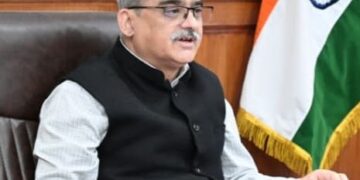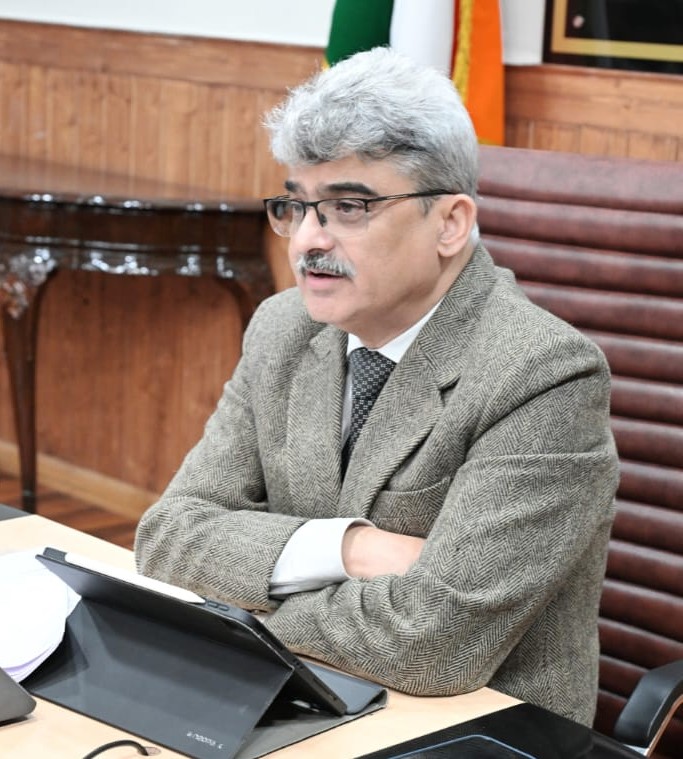
JAMMU: Chief Secretary, Atal Dulloo, today chaired the Union Territory Level Standing Committee (UTLSC) meeting on the Pradhan Mantri Gram Sadak Yojana (PMGSY) to review the progress and future roadmap of PMGSY–IV, a flagship rural infrastructure programme aimed at providing all-weather road connectivity to newly eligible rural habitations across J&K.
The meeting was attended by Additional Chief Secretary, Public Works (R&B) Department; Director, National Rural Infrastructure Development Agency (NRIDA); Principal Secretary, Finance; Secretary, Rural Development Department; Engineer-in-Chief (Works); Chief Engineers, PMGSY Jammu/Kashmir, besides other concerned senior officers.
During the meeting, the ACS, Public Works Department made a detailed presentation on the implementation status of PMGSY-IV, outlining its objectives, eligibility criteria, funding pattern and district-wise proposals for the year 2025–26. The presentation highlighted the significant progress achieved in strengthening rural road infrastructure under the scheme.
The main highlight of the meeting is that the UTLSC accorded its approval to PMGSY-IV Batch–II proposals to be forwarded to the Ministry of Rural Development (MoRD) for sanction and funding. This batch comprises 1,487 new road works proposed across various districts of Jammu and Kashmir, covering a cumulative road length of 7,276.676 kilometres at an estimated cost of ₹16,256.82 crore.
These projects are aimed at providing new road connectivity to 1,626 unconnected rural habitations across the Union Territory. As per scheme guidelines, the proposals also incorporate a projected maintenance cost of ₹1,300.55 crore and a renewal cost of ₹1,950.82 crore, ensuring sustainability of the created assets.
It was informed that border districts including Rajouri, Poonch, Kathua, Doda, Baramulla and Kupwara feature prominently in terms of road length and number of habitations proposed, reflecting a focused thrust on difficult, border and hilly regions.
Reviewing the status of PMGSY-IV Batch–I (2025–26) works, the Committee was apprised that 316 road works have already been sanctioned across Jammu and Kashmir, of which 221 roads pertain to Jammu Division and 95 roads to Kashmir Division. Out of these, 313 works have been tendered, while 292 roads have reached the stage of issuance of Letter of Acceptance (LoA), Notice to Proceed (NTP) or agreement execution.
Elaborating on the objectives of PMGSY-IV, it was explained that the Ministry of Rural Development, Government of India, has approved the scheme to connect rural habitations that have become eligible due to population growth as per Census 2011. The scheme is being implemented for a period of five years from 2024–25 to 2028–29.
Under PMGSY-IV, population-based eligibility has been fixed at 500+ population in plains and 250+ population in hilly areas, including Jammu and Kashmir, as per Census 2011. The distance eligibility follows a cluster-based approach to ensure prioritisation of viable habitations for road connectivity.
The Committee was also informed that the cost-sharing pattern for Jammu and Kashmir is 90:10 between the Centre and the UT, in accordance with provisions applicable to Himalayan States.
For prioritisation of works, a Comprehensive New Connectivity Priority List (CNCPL) has been prepared at Block and District levels, factoring in population size, aspirational district status, Scheduled Tribe concentration, convergence with other Central Government schemes and PMGSY-IV eligibility norms.
The Chief Secretary emphasised the need for time-bound execution, rigorous monitoring and early resolution of legal and procedural bottlenecks. He directed the concerned departments to ensure quality construction, timely commencement of sanctioned works and strict adherence to maintenance commitments, so that the intended benefits of improved rural connectivity reach the people without delay.
The construction of these roads is expected to significantly enhance access to education, healthcare, markets and growth centres, thereby accelerating socio-economic development in rural and remote areas of Jammu and Kashmir.