JAMMU: Minister for Jal Shakti, Forest, Ecology & Environment and Tribal Affairs, Javed Ahmed Rana, today said that tribal heritage constitutes a living, dynamic knowledge system embedded in language, belief structures, customary practices and social organisation.
He emphasised that its preservation requires a participatory, community-driven research framework that acknowledges indigenous epistemologies and lived traditions.
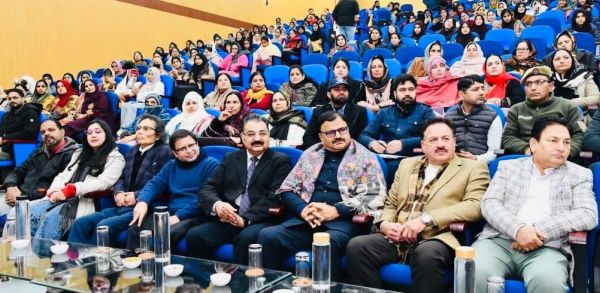
The Minister was addressing a workshop, as the chief guest, titled “Mapping Tribal Heritage”, organised by the Indian Institute of Technology (IIT) Jammu. The workshop focused on digital documentation, archival technologies and critical engagement with cultural expressions, oral narratives and socio-cultural formations of indigenous communities across India.
Rana asserted that safeguarding tribal heritage cannot be an external intervention alone but must be rooted in community stewardship and intergenerational transmission.
“Tribal heritage can survive only when communities become active custodians of their own traditions. Preservation must evolve organically from within those who live, practise and transmit this heritage every day,” he said.
Highlighting the intrinsic relationship between language vitality and cultural continuity, the Minister stated that languages survive only through sustained community use and institutional support.
Referring to Gojri, he noted that it is not merely a contemporary mode of communication but a language with a deep historical and civilisational lineage, whose speakers are its authentic inheritors and protectors.
The Minister lauded IIT Jammu’s pioneering engagement with tribal research, describing it as a socially responsive academic initiative. He remarked that the Institute has ventured into an area where few technical institutions have tread and congratulated IIT Jammu for integrating technology-driven methodologies with humanities-based inquiry to preserve cultural heritage for future generations.
Drawing attention to history, Javed Rana referred to the Gurjar–Pratihara legacy, urging the scholars to undertake rigorous historical and archaeological research to document the contributions of the Gujjar-Bakarwal community in art, architecture and state formation. He encouraged the Institute to further expand the scope of its research to ensure historical justice and accurate representation.
He also emphasised the value of interdisciplinary research, noting that the convergence of technology, social sciences and public policy enables evidence-based governance.
“Such research empowers the governments to design informed, inclusive and need-based welfare programmes for marginalised and indigenous communities,” he said.
The Minister encouraged IIT Jammu to pursue policy-oriented and applied research in areas such as resettlement, seasonal migration, climate change adaptation and sustainable livelihoods. He stressed that academic outputs must translate into improved governance and tangible benefits at the grassroots level.
Assuring full cooperation from the Tribal Affairs Department, he stated that scholars, writers, cultural practitioners and poets would be actively engaged in future research initiatives. He reiterated the government’s commitment towards strengthening initiatives such as the Tribal Chair, affirming sustained institutional support for preserving the rich cultural and civilisational heritage of tribal communities.
On the occasion, IIT Jammu launched a dedicated digital portal for tribal knowledge documentation, envisioned as an open-access repository hosting archival documents, ethnographic records, photographs, audiovisual materials and research outputs related to tribal heritage, culture and welfare initiatives. The platform aims to provide curated, authentic and easily accessible information for researchers, policymakers and communities alike.
Earlier, setting the context of the workshop, Head, Department of Humanities and Social Sciences, Dr Amitash Ojha, stated that documenting and safeguarding local cultures is a shared societal responsibility. Dr Ojha added that the workshop aimed to disseminate ongoing research and foster collective engagement in cultural preservation.
Highlighting the linguistic challenges, he observed that much of the knowledge related to the Gojri language remains undocumented and undigitised and that developing a comprehensive digital corpus and linguistic dataset for Gojri is a core research priority of the Institute.
Dean Planning and Management, IIT Jammu, Dr Anurag Mishra, stated that the Humanities Department has adopted a specialised, community-centric approach towards working with marginalised populations and is making steady progress.
Secretary, Kala Kendra, Dr Javid Rahi, expressed pride in IIT Jammu’s efforts to conduct research in tribal communities’ native languages, stating that such an approach ensures authenticity and inclusivity.
Dr Rahi underscored the importance of tribal heritage mapping as a tool for visually representing the cultural geography of Jammu and Kashmir. He called for focused documentation of tribal artisanship, particularly in regions such as Poonch and Bandipora, including traditional attire, craftsmanship and material culture. He also praised the work of women artisans in Kupwara, especially their expertise in beadwork and indigenous crafts.
On this occasion, a documentary titled ‘Zuban-e-Kalam’ was released, capturing the lived experiences of tribal communities.
Speaking about the documentary, Professor Quleen Kaur said the initiative seeks to ensure that tribal cultural heritage is preserved for future generations. She noted that over the past two years, the research team has engaged closely with communities, documenting migration experiences, recording oral histories, and tracing the intergenerational transmission of songs and narratives.
She added that the project also documents marriage and funerary rituals, as well as how tribal communities negotiate the impacts of development on traditional ways of life. These efforts, she said, are contributing to the creation of a comprehensive digital repository of the Gujjar–Bakerwal community, serving as a critical resource for research, policymaking and cultural preservation. Professor Garima Singh presented the vote of thanks.