
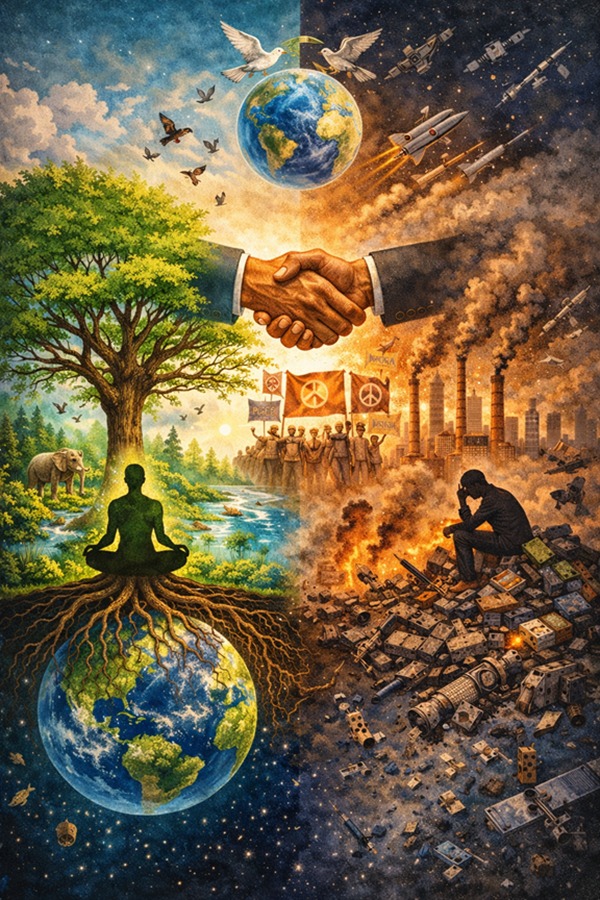
There is an idea that may sound controversial at first: we do not really “come into” this world, but rather come out of it. Like trees, rivers, animals, and soil, human beings are formed from the same natural world. If we think calmly and without resistance, this idea can be understood through simple common sense.
Unfortunately, in our pursuit of happiness and comfort, many of us have lost touch with our roots. We have become so busy chasing money and commercial dreams that we have forgotten how deeply connected we are to nature. Human beings are not separate from the natural world; we are part of a larger whole where every living thing is connected.
Take trees as a simple example. They do not just give us wood, fruits, and shade. They give us oxygen, without which we cannot survive. In nature, everything depends on something else. Life works in cycles of birth and death, growth, and decay. We do not need to understand complex science or philosophy to grasp this, just observe how life around us functions.
When we eat plants or animals, they become part of our bodies. In this sense, we literally become what we consume. Yet many humans believe they are superior to all other living beings and that nature exists only for their use. History shows how mistaken this belief is. Powerful species like dinosaurs once ruled the Earth and then disappeared. The planet survived them, and it will survive humans, too. Nature has no bias or preference; it only changes form and continues life.
One thing that unites all humans, regardless of belief or culture, is greed, the desire for more. This greed has led not just to the use of nature, but to its abuse. Uncontrolled industrialisation, destruction of forests, pollution of water, and exhaustion of resources are all results of this endless hunger for more.
The same mindset of dominance and control has also pushed humanity toward dangerous pursuits. Weapons of mass destruction, developed in the name of power and superiority, pose a constant threat to life on Earth. Similarly, the race for space, driven by competition rather than responsibility, is adding to environmental damage. Thousands of satellites and growing amounts of space debris now orbit the planet, and this clutter may one day block our view of the stars, symbols that once inspired curiosity, humility, and wonder about our place in the universe.
At the heart of many of these problems lies consumerism. Consumerism encourages people to believe that happiness comes from buying more goods and services, often things they do not truly need and cannot afford. This culture became especially strong in capitalist societies. As early as 1955, retail analyst Victor Lebow openly stated that modern economies depend on turning consumption into a way of life, where people seek emotional and spiritual satisfaction through buying, using, and discarding things at an ever-increasing pace.
Consumerism has serious negative effects. It depletes natural resources, increases pollution, and accelerates climate change. It also creates social problems like debt, inequality, anxiety, and dissatisfaction. While it does create jobs and economic growth, these benefits are often overshadowed by the damage it causes to both the planet and human well-being.
It is true that a growing consumer class can be positive, as it means more people are lifted out of poverty and gain access to better living standards. However, this growth also brings major challenges. By 2030, the world is expected to have around 5.6 billion consumers. This will massively increase demand for energy, food, water, clothing, electronics, housing, and transportation.
The consequences are alarming. Rainforests may disappear by the end of this century if deforestation continues at the current rate. Fresh water is being consumed faster than the Earth can replenish it, raising fears of severe water shortages by 2040. Oceans are already overfished, and studies warn that seafood could nearly vanish by 2048 if current practices continue.
Our consumer society works like a straight line: it takes resources from nature, turns them into products, and then dumps them as waste. But nature is not infinite. A system like this cannot continue forever and is bound to collapse.
While corporations often claim they have no moral responsibility beyond profit and shareholders, consumers do have power. Every purchase is a choice. By choosing wisely, consuming less, and respecting nature, people can help slow environmental destruction and even reverse climate change.
The real change begins when we remember a simple truth: we are not separate from nature. We are nature. Protecting it is not an option; it is a necessity for our own survival. As responsible citizens of planet Earth, we must also look beyond personal choices and influence our governments and systems to move away from the production of weapons and toward peace and cooperation. Our responsibility does not end at reducing waste on land and in our oceans; it must also extend beyond the planet, ensuring that even outer space is not turned into another dumping ground. Only through awareness, restraint, and collective action can we hope to preserve the delicate balance that sustains life.
The author is a painter, writer, and senior marketing professional with more than 25 years of experience working with leading semiconductor companies and can be reached at aijazqaisar@yahoo.com.