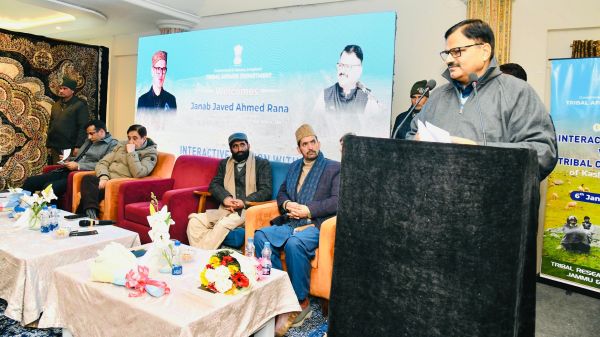
SRINAGAR: In a major outreach initiative reflecting the government’s commitment towards participatory and inclusive governance, Minister for Jal Shakti, Forest, Ecology & Environment and Tribal Affairs, Javed Ahmad Rana, today chaired an exclusive interactive session with the eminent personalities from the tribal communities of Kashmir division at Srinagar.
The day-long interaction brought together a distinguished gathering of tribal artists, writers, poets, social activists, conservationists, public representatives and community leaders, providing a meaningful platform for direct dialogue between the government and grassroots voices. The session was aimed at capturing the lived experiences and informed suggestions to refine the government’s policies and programmes for tribal welfare.
Addressing the gathering, Javed Ahmed Rana described the interaction as a collaborative effort rather than a routine meeting. He stressed that genuine tribal upliftment must be shaped by the aspirations and lived realities of the communities themselves.
“This interaction reflects our shared responsibility towards inclusion, empowerment and dignity of tribals. Development can be sustainable only when it is guided by the voices of those it seeks to serve,” the Minister said.
He underlined the critical role of domain experts, elected representatives and socially influential voices in shaping effective policies and monitoring their execution, particularly in remote and tribal dominated areas of Jammu and Kashmir.
“This approach fosters collaborative governance, where policy intent aligns with the ground realities. When community wisdom and administrative action move together, public welfare outcomes become meaningful and lasting,” Rana observed.
The Minister urged the writers, artists, poets and civil society leaders to take the lead in initiatives for the welfare of tribal and other vulnerable communities. He noticed that their cultural and social influence places them in a unique position to guide and mobilize society.
He said the interactive session would serve as a strategic platform for sustained engagement, enabling the government to respond to the evolving social, cultural and economic needs of tribal populations.
Emphasising the vision of “Responsive Governance,” he assured participants that the insights shared would directly inform the future policy frameworks.
Education emerged as a key focus area during the deliberations. Rana reiterated that tribal education remains a top priority of the government, with special emphasis on quality residential education through upgraded hostels, timely scholarships for Scheduled Tribe students and organised educational exposure programmes to ensure that no tribal child is left behind.
He informed that infrastructure in Gujjar and Bakarwal hostels is being strengthened alongside the implementation of the Eklavya Model Residential Schools (ERMS) to ensure quality education.
Highlighting the importance of balancing development with tradition, the Minister stressed the need for systematic documentation and preservation of tribal history, languages, art and oral traditions. He said cultural preservation is central to strengthening tribal identity and self-respect, and institutions like the Tribal Research Institute would play a pivotal role in this effort.
On livelihood generation, the Minister emphasised promotion of eco-tourism through tribal homestays, particularly in border and remote areas and strengthening of Van Dhan Vikas Kendras to add value to forest produce. These initiatives, he said, are designed to enable tribal communities to become self-reliant entrepreneurs while maintaining ecological balance.
Reaffirming the government’s commitment to tribal rights, Minister Rana emphasized that implementation of the Forest Rights Act (FRA) remains a priority, with focused efforts to ensure legal security over land and forest resources through strengthened institutional mechanisms.
He stated that the Omar Abdullah led Government is fully committed to the comprehensive development and well being of tribal population across Jammu and Kashmir. He also highlighted the Union Government’s renewed focus on tribal welfare and stressed the need for coordinated, mission-mode implementation of welfare initiatives.
The Minister outlined key schemes being implemented for tribal welfare. These included the Capex Budget, Special Central Assistance to Tribal Sub-Scheme (SCA to TSS), Pradhan Mantri Aadi Adarsh Gram Yojana (PMAAGY), Dharti Abha Janjatiya Gram Utkarsh Abhiyan (DA-JGUA) and the Pradhan Mantri Van Dhan Yojana (PMVDY).
The interactive session was attended by MLA Kokernag, Zaffar Khatana, DDC Chairperson Anantnag, Mohammad Yousuf Kohli and DDC Vice Chairperson Anantnag Nazir Choudhary besides Director Tribal Affairs, Deputy Director Tribal Affairs Jammu and Nodal Officer, Tribal Research Institute and Deputy Director Tribal Affairs Kashmir.
Prominent citizens, writers, artists, poets and representatives from various tribal communities of the Kashmir Division actively participated in the deliberations and placed their demands and suggestions before the Minister. Key issues raised included upgradation of facilities in tribal areas, documentation of oral histories, promotion of tribal languages and culture and streamlining of forest-related clearances for community welfare activities.
The Minister directed the concerned officers to ensure prompt and time-bound redressal of the issues raised.