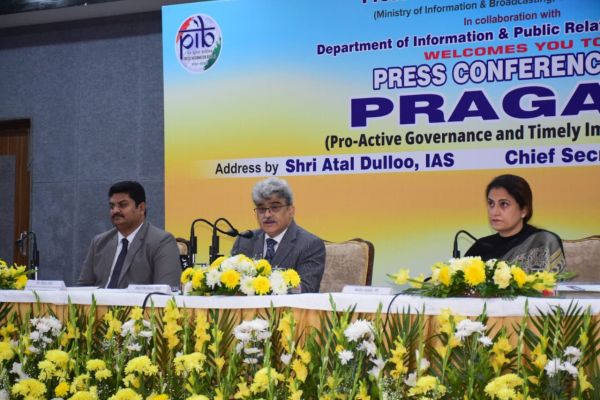
Jammu: Jammu and Kashmir Chief Secretary, Atal Dulloo today said that world-class infrastructure is being developed across Jammu and Kashmir, with mega projects being fast-tracked through coordination between the Centre and the Union Territory under the PRAGATI mechanism.
Addressing a press conference organised by the Press Information Bureau (PIB) Jammu and the Department of Information and Public Relations (DIPR), the chief secretary said 61 projects worth Rs 4.12 lakh crore are currently being monitored on the Project Monitoring Group (PMG) portal in the region.
“Of these, 15 projects worth Rs 69,000 crore have been completed, while 46 projects worth Rs 3.43 lakh crore are under implementation at various stages. Under PRAGATI (Pro-Active Governance and Timely Implementation), 15 high-priority projects worth Rs 1.12 lakh crore in Jammu and Kashmir are being closely monitored by the Prime Minister,” Dulloo said.
He noted that 59 issues related to these projects have been discussed so far, with 57 of them — around 96 per cent — resolved. These issues were primarily related to land acquisition, environmental clearances, financial approvals and construction bottlenecks. The projects span key sectors including connectivity, energy and social infrastructure.
Highlighting the impact of the PRAGATI framework, Dulloo said six high-priority projects worth Rs 53,000 crore have been completed or commissioned. These include the Jammu–Udhampur–Srinagar–Baramulla Rail Link, the NH-44 Srinagar–Banihal project, the Kishanganga hydroelectric project, utility shifting issues for AIIMS Jammu, and the Alusteng transmission system linking Srinagar with Ladakh.
Responding to a query regarding delay in completing AIIMS Srinagar, the chief secretary said the facility should be ready “by the end of this year”.
When asked if the suspension of the Indus Waters Treaty would accelerate power projects by overruling the objections from Pakistan, Dulloo said “all those restrictions have gone now with the Indus Waters Treaty being kept in abeyance. So it is expected that the pace of execution of projects will further improve”.
He said nine projects worth Rs 59,000 crore are under active PRAGATI monitoring. These include the Delhi-Amritsar-Katra Expressway, AIIMS Awantipora, the Pakal Dul hydroelectric project and the 4G saturation scheme under the Universal Service Obligation Fund. Of the 29 issues identified in these projects, 27 have been resolved, he added.
Dulloo said the high resolution rate reflects the effectiveness of ICT-enabled monitoring framework and sustained follow-up at the UT and district levels. He added that PRAGATI also reviews social sector schemes and public grievances to strengthen governance.
Meanwhile, PIB Director Neha Jalali on Monday said that PRAGATI has emerged as a powerful instrument of digital governance, effectively translating intent into tangible outcomes by breaking bureaucratic inertia and strengthening Centre–state coordination.
“PRAGATI is a powerful illustration of how digital governance can effectively translate intent into tangible and visible outcomes. It is not merely a review platform, but a transformative governance mechanism aimed at breaking bureaucratic inertia, strengthening the Team India approach through enhanced coordination between the Centre and states, and fostering a culture of time-bound decision-making, accountability and outcome-based monitoring,” Jalali told reporters here.
Citing the Jammu–Udhampur–Srinagar–Baramulla (JUSBRL) rail link as an example, she said work on the project began in 1995 but saw limited progress for nearly 25 years due to difficult terrain, land acquisition issues, forest clearances and security-related constraints.
She said that after the project was taken up under the Pro-Active Governance and Timely Implementation (PRAGATI), critical approvals and statutory clearances were expedited and long-pending bottlenecks were resolved through sustained coordination among various ministries and agencies.
“This coordinated and proactive approach ultimately led to the completion of the project, enabling operational rail connectivity in the Kashmir valley and marking a major milestone in the region’s infrastructure development,” Jalali said.
The Jammu–Baramulla railway line is part of the Udhampur–Srinagar–Baramulla Rail Link (USBRL) project, a 324-km strategic broad-gauge railway connecting the Kashmir valley with the national rail network.
Prime Minister Narendra Modi, in June last year, inaugurated key railway projects, including the USBRL, featuring the Chenab Rail Bridge and the Anji cable-stayed bridge, connecting the Kashmir valley with the rail network for all-weather travel. He also flagged off a Vande Bharat Express train from Katra to Srinagar.
The event was held against the backdrop of the 50th PRAGATI meeting chaired by Prime Minister Modi on December 31, 2025, in New Delhi. (With PTI Inputs)