New Delhi: Union Home Minister Amit Shah on Friday praised the investigation into the Pahalgam terror attack and Delhi blast cases, stressing that they are not cases of ordinary policing but “outstanding examples of watertight investigation”.
Lauding the security forces for neutralising the perpetrators of the Baisaran Valley (Pahalgam) terror attack, Shah said the “terrorists wanted to disrupt communal harmony in the country and deliver a blow to the new era of development and tourism that has begun in Kashmir”.
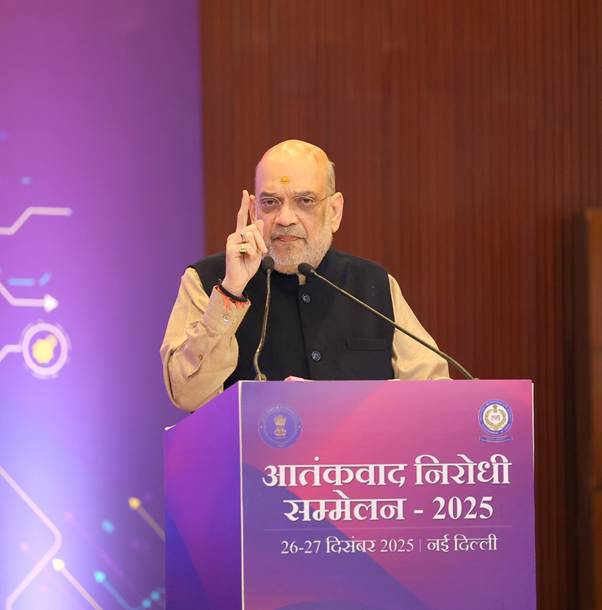
Inaugurating a two-day Anti-Terror Conference organised by the National Investigation Agency (NIA) here, he said that the results of the investigation into the Pahalgam terrorist attack will put Pakistan in the dock on international platforms.
The home minister said that the security forces neutralised all three terrorists based on extremely precise intelligence, delivering a stern message to Pakistan.
“This is the first terrorist incident in which those who planned the terrorist act were punished by us through Operation Sindoor, and those who carried out the act with the weapons provided to them were neutralised through Operation Mahadev,” he said.
Shah said at both ends, the government of India, the Indian security forces and the people of the country “have given a strong and befitting reply to Pakistan’s terrorist masters through security forces and intelligence agencies”.
The minister said a complete and successful investigation was conducted of the Pahalgam terrorist attack, which agencies around the world will study.
Shah praised the investigation of the Jammu and Kashmir Police and Delhi Police in exposing the complete network behind the Red Fort area blast case.
“…investigations into the Pahalgam and Delhi blast cases are not ordinary policing but outstanding examples of watertight investigation. This is also a great example of how an alert officer can save the country from such a major crisis by remaining vigilant at all times,” he said.
He mentioned that the landscape of terrorism in the world is now changing due to the use of technology in terrorist incidents alongside technological advancements, and we too must prepare to prevent this. He said that it is the national responsibility of this conference to anticipate invisible future challenges and to prevent them.
Shah said that all agencies of the government of India, together with the state police, should form a ‘Team India’ that works effectively for national security.
‘Planning a 360-degree assault on organised crime’
Union Home Minister Amit Shah on Friday launched two databases – the Organised Crime Network Database and the Weapons Database for lost, looted & recovered arms – hosted by the National Investigation Agency.
The databases are meant to be used by law enforcement agencies across the country.
The minister said a new plan to launch “a 360-degree assault on organised crime” would be brought in the coming days, and that these databases would form “a core asset of the zero-terror policy.”
Shah made the remarks while inaugurating the Anti-Terrorism Conference-2025, organised by the NIA on Friday, when he also unveiled the NIA’s updated crime manual, besides the two databases.
Addressing the two-day conference attended by top police and central agencies officers from across the country, Shah highlighted links between organised criminals and terrorists.
“Organised crime networks initially operate for the purpose of ransom and extortion, but when their leaders flee abroad and settle there, they automatically come into contact with terrorist organisations and then use the proceeds from ransom and extortion to spread terrorism within the country,” he said, according to a statement.
Every state must, under the guidance of the NIA and CBI, with the cooperation of the IB, and by utilising this database, eliminate it within their jurisdiction, Shah said.
He said that everyone should move forward with the principle of ‘Duty to Share’ instead of ‘Need to Know.’
Central agencies and state police have made good use of technology at their level, but technology developed in silos and data collected in silos are like a gun without bullets, the statement quoted him as saying.
Shah said it is better if all data can communicate with each other and are created using the same technology.
“For this purpose, the Ministry of Home Affairs, NIA, and IB should hold discussions to develop a seamless national-level framework for technology and data, and should support the states in strengthening it,” he said.
The minister said the database of terrorists and criminals should be made a core asset of the zero-terror policy.
Shah said he expects the director generals of police to implement the database framework in letter and spirit.
In the coming days, Shah said, the country would bring a plan to launch a “360-degree assault on organised crime.”
The home minister said a new standard of coordination, cooperation, and communication has been developed among the DGP Conference, Security Strategy Conference, N-CORD meetings, and the Anti-Terror Conference.
“We cannot view these four pillars in isolation; running through them as a common thread is the Anti-Terrorism Conference,” Shah said.