The Kochi-Muziris Biennale is an international exhibition of contemporary art held in the city of Kochi, Kerala, India. It is the largest art exhibition in the country and the biggest contemporary art festival in Asia. Its sixth edition takes place on 12 December 2025 and will run until 31 March 2026. The Biennale brings together an international gathering of artists and visitors, offering a contemplative space for engagement with contemporary art. This edition features 66 artists from around the world, presenting their works and projects alongside a wide range of associated events and exhibitions.
Among these 66 artists is Moonis Ahmad Shah, a contemporary artist from Kashmir, who is presenting his artworks. His multidisciplinary practice spans interactive installation, video installation, video, photography, digital collage, 3D printing, sound sculpture, and programming. Ahmad completed his doctoral research at the University of Melbourne in 2022. His work has been exhibited in numerous solo and group exhibitions, both nationally and internationally. He has also participated in several artist residency programs, including a ten-month residency at Akademie Schloss Solitude, Stuttgart, Germany, from 2022 to 2023.
Moonis’s approach to art-making is distinctive, shaped by his critical understanding of the contemporary political construction of the world. Through the perspectives and techniques he employs, he engages with complex and critical dialogues surrounding political subjugation and suppression. His practice addresses the experiences of being, time, and death at marginalities; within these intersecting temporalities, he seeks out texts, images, and stories that reveal suppressed and marginalized histories.
He presents evidence of a depraved and fractured world through detailed visual imagery and multifaceted programmed machines that are both active and interactive for the viewer. As Moonis notes, “I investigate and speculate on what it means to live in a marginality where life, death, and different planes of temporalities intertwine.” Central to his practice are the effects of human relationships within the Anthropocene, as well as power dynamics between humans themselves. The relationships of the state and its procedures of power enforced on marginalized communities form a persistent space—one in which the artist situates his own position. Through this engagement, Moonis argues that he aims to “conjure the afterlives of the dead as a means of speculating on the emergence of counter-worlds that challenge established configurations of power at the margins.”
Moonis’s critical engagement with the assemblage of diverse material components remains a central concern in his practice. His installations articulate the conjunction of ideology and manipulation, demonstrated through the careful arrangement of materials and the functional logic of his works. Employing motors, sensors, programming, automatic switches, wiring, and sound, his installations operate as complex systems rather than static objects. While these works present multiple layers of complexity that actively engage the viewer, the artist remains precise and deliberate in articulating the role of power within ideological structures and mechanisms of suppression.
Arushi Vats writes, “Drawing on hauntological and posthuman frameworks, Moonis speculates on radical ruptures that destabilize the epistemes and technologies of colonial power. Through a heightened attentiveness to insurgent and radical agencies that emerge within and against infrastructures of colonial erasure, his practice resists the narratological limits imposed by such violence. Instead, it listens to spectres, glitches, and negations as sites of resistance, rearticulation, and potential liberation.”
 At the Kochi-Muziris Biennale, Moonis presents a suite of works that disassemble and subvert the modalities of siege-enforced disappearances, absented records, curfewed time, and suspended communication, attuning viewers to the ruptures of autonomous life. The works presented include Accidentally Miraculous Everyday from that Heaven (2021), Almost Entirely Sisyphus (2021), All that you make Disappear in my Fret is, but Immortal (2023–ongoing), and Dilli Ke Panni Se Kashmiri Paani Banana Ke Machine (2025).
Accidentally Miraculous Every Day from That Heaven (2021) is a video installation comprising a multi-channel video projection, prints, and text etched on steel. The work employs photogrammetry to stitch together a collection of two-dimensional images into three-dimensional reconstructions of people living under a state of exception. This process of stitching—at times successful, at times broken and fractured—functions as an allegory of the impossible stitch, behind which stories, histories, and regional figures become inaccessible.
The everyday lives, voices, and narratives of these figures linger in the interstices between absence, the sayable, and the unsayable. Yet the work generates a sensibility of what it means to live, experience, and make sense of existence within a state of exception. These fragmented reconstructions of the everyday offer a meditation on what happens when nothing appears to happen. Moving away from the presentation of images through a singular viewpoint, the work instead embraces abstraction, inconsistency, and the overlapping of multiple perspectives.
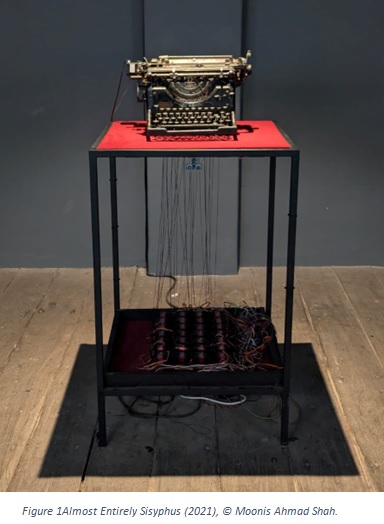
In Almost Entirely Sisyphus (2021), a re-engineered typewriter with servo motors, individually connected to each key and programmed via an Arduino board, transforms the typewriter into an autonomous machine. Drawing from an archive of names of people who have disappeared in conflicts across different times and territories, the typewriter endlessly types these names—without paper. This absence renders the names as unregistered gestures, foregrounding the impossibility of documenting disappearance and subverting the typewriter’s historical role as a bureaucratic tool of record and control.
The mechanical function of the typewriter, an object that carries its own layered history, evokes memory the moment it is seen in operation. Though the typewriter is an old apparatus, in the present it is reconstituted through servo motors and programmed mechanisms. This transformation renders it a haunted object: an archival machine that types the names of disappeared persons—individuals erased from historical records. In this work, the machine becomes both witness and announcer. Its voice is not linguistic but sonic; the viewer hears only the sounds of pressing keys, motors, and mechanical movements. Yet this sound demands attention, as each keystroke corresponds precisely to the names programmed into the system. The experience is engaging and unsettling—entirely Sisyphian—circulating the names of those whose deaths remain unknown and returning them endlessly into presence through repetition.
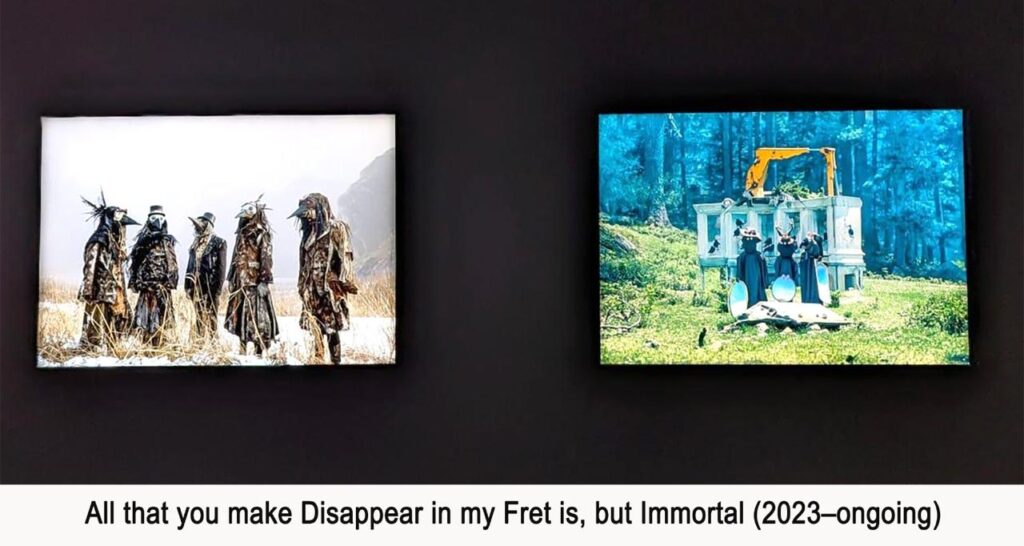
All that you make Disappear in my Fret is, but Immortal (2023–ongoing) presents a series of images staged through a darkly humorous, representational theatre. The work questions presence within space and our relationship to it, where landscapes function as key markers of identity. Yet these identities have been altered through different periods of colonization, as communities adapt to imposed conditions, producing new identities that unsettle the landscapes from which they emerge. In many respects, the images appear as dreamlike compositions populated by projectile remnants and distant landscapes. Their mutant morphologies refuse the linear temporality of siege, instead reclaiming detritus as agentic matter and foregrounding the persistence of altered identities within conditions of prolonged violence.
The works Moonis presents at the Kochi-Muziris Biennale create a space for imagination and reflection. In the room where Almost Entirely Sisyphus and All that you make Disappear in my Fret is, but Immortal are exhibited, the encounter unfolds between text, characters, and images. The images appear to echo the characters indicated by the typewriter, suggesting visual embodiments of the names it inscribes.
Through these images, viewers are invited to imagine figures that remain deliberately unrecognizable, opening multiple interpretations. Within this ambiguity, the region emerges as more significant than its inhabitants, who are compelled to produce documents to prove their belonging to the land. The works thus foreground the tension between territory, identity, and bureaucratic regimes of recognition.
Dilli Ke Paani Se Kashmiri Paani Banana Ki Machine (2025) presents a machine composed of two interconnected components: one that controls and regulates, and another that performs the visible labor of the work, evoking the functions of the mind and the heart. The first component consists of a stand embedded with programmable electronic elements that manage and control the second component, a steel trunk box fitted with various laboratory apparatuses and bottles. Through a network of plastic pipes, water is transferred between these different vessels, activating the system.
The machine’s operation generates curiosity through its systematic and procedural mechanisms. Conceptually, the work divides water into categories of purity, a metaphor that parallels the superficial construction of beauty attached to specific places—an aesthetic logic through which landscapes are colonized. In contrast, the work poses a critical question: what is the actual reality of these places when they are polluted and transformed through policies, development, and extractive practices? Arushi Vats writes, “the absurdity of the machine imagination underpinning colonial projects and ethnonationalist phantasmas is treated with irony, as an apparatus attempts to entrap and manoeuvre water among various glasses. Leaks, slippages, and spills laugh against such desires to control and subjugate landscapes, underscoring the endurance of ecologies, beyond the scales of human time.”
This exhibition of Moonis’s works foregrounds methods of conjunction and assemblage through materials, subjects, critiques, attitudes, technologies, and metaphors. Rather than offering a singular interpretation, the works open onto multiple readings that move between lived realities and layered regimes of records, people, places, objects, and histories. Collectively, the works articulate the artist’s concerns through the gathering of disparate elements, constructed within space to foreground significant evidence and events. Their value lies not in aesthetic beautification but in critical engagement.
For the viewer, the encounter unfolds through time, as curiosity persists around how the works function and the technologies they employ. These technical systems operate within, and in response to, chaotic political conditions, revealing another dimension of the practice: the use of technology to both mirror and critique structures of control. In this way, Moonis situates his practice within the political realities of the region to which he belongs, exposing technology as a powerful instrument of governance, surveillance, and domination.
Reflecting on his participation in one of the largest art events in South Asia, Moonis notes that taking part in the Kochi-Muziris Biennale allows diverse audiences from across the subcontinent to encounter his work. He explains that his practice reflects the contemporary history of his region while engaging viewers through interactive mechanical and automated systems, as well as digitally created images projected through light boards and projections. While the Biennale’s curatorial team was supportive, he observes that it required time for them to fully grasp the curatorial and conceptual framework of his installations.
At this stage of his career, Moonis Ahmad Shah has achieved significant international recognition. His accomplishments have brought greater visibility to Kashmir through contemporary art practice. His work reflects post-critical approaches to the mechanisms of living, examining the interconnections between human life, machine systems, and the various ways in which state power is exercised to manipulate people—often without being recorded in official histories. Through his practice, he seeks to investigate data and archives of an unacknowledged or absent world.
Moonis began his artistic journey in search of knowledge and creative expression, traveling across different parts of the world. Educated in Melbourne, he has moved between India and Australia, shaping his practice through diverse cultural and intellectual contexts. As an artist, academic, researcher, teacher, engineer, and scientist, he stands as an inspiration for future generations.