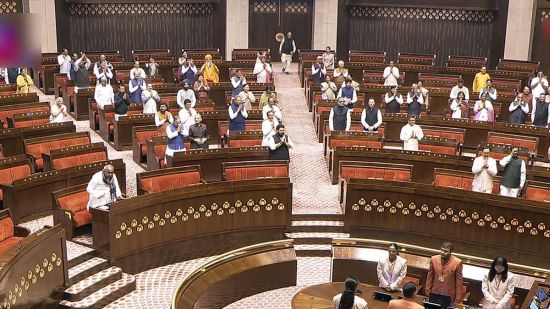
New Delhi: Opposition MPs Wednesday strongly pitched for sending the nuclear energy bill moved by the government to a parliamentary panel for wider consultations while members from the ruling coalition “wholeheartedly” supported the legislation saying it will prove helpful in making the country energy sufficient.
Participating in the debate in Lok Sabha on the Sustainable Harnessing and Advancement of Nuclear Energy for Transforming India (SHANTI) Bill, which seeks to open the tightly-controlled civil nuclear sector for private participation, BJP member Shashank Mani said every Indian will be benefitted from the measure.
He said the bill will facilitate government and private sectors investment in nuclear energy sector, generating employment.
Initiating the debate, Congress member Manish Tewari opposed the bill, contending that the omitting the clause removing liability on suppliers of nuclear equipment would prove to be harmful for India in case of a nuclear incident.
He opposed the provisions in the bill for the repeal of the Atomic Energy Act of 1962 and the Civil Liability for Nuclear Damage Act of 2010.
Tewari recalled that the Department of Atomic Energy was set up by India’s first prime minister Jawaharlal Nehru and the first nuclear tests were carried out by former prime minister Indira Gandhi in 1974.
He said former prime minister Atal Bihari Vajpayee ordered the second series of nuclear tests in 1998, and his successor Manmohan Singh brought India out of the nuclear apartheid.
Tewari said the bill does not provide for a framework for handling radioactive waste and seeks to prioritise uranium-based reactors at the cost of thorium reactors and molten salt reactors, which form the mainstay of India’s three-stage nuclear programme.
The Congress member demanded that the bill be referred to a Joint Parliamentary Committee (JPC) for careful examination before being presented in the House for passage.
Former Union minister and Congress MP Shashi Tharoor described the bill as a “dangerous leap into privatised nuclear expansion” without adequate safeguards and asserted that the pursuit of capital cannot be allowed to override the requirements of public safety, environmental protection and victim justice.
Participating in the debate, he claimed that the proposed legislation is ridden with exceptions, heavy on discretion and largely indifferent to public welfare.
“I am not sure whether it is a nuclear bill or an unclear bill,” he said.
Tharoor said the bill represents a “dangerous leap into privatised nuclear expansion” with inadequate safeguards.
“We cannot allow the pursuit of capital to override the non-negotiable requirements of public safety, environmental protection and victim justice,” he asserted.
Shiv Sena (UBT) leader Arvind Sawant questioned how the government would ensure that a private company provides the same level of safety as the public sector.
He urged that the bill be sent to a JPC for comprehensive discussion and then brought back with a consensus.
Meanwhile, JD(U) leader Alok Kumar Suman said that the process of issuing licenses for the operation of nuclear power plants should be of the highest standard.
He said that there is a need to make special provisions for the disposal of radioactive waste.
Shiv Sena leader Dhairyasheel Sambhajirao Mane said that the government has retained special powers for the safety of radioactive materials, “meaning that innovation can be done by the private sector, but the control will remain with the government.”
Samajwadi Party member Aditya Yadav, while participating the debate, strongly opposed it saying the bill will offer red carpet welcome to the foreign companies “ignoring the country’s interest”.
“This is an attempt to bring US and French companies. If you are opening up the nuclear energy sector to foreign companies, where is your Make In India programme,” he asked.
Yadav claimed that through this bill, the Modi government is trying to please the Trump administration and lower the tariff imposed by the United States on India.
Urging the government to send the bill to a Select Committee, TMC member Saugata Roy said nuclear energy is a “risky proposition” and the government has put maximum liability in case of an accident at just USD 300 million.
The liability should be USD 500 million, he said, adding, if accident takes place, the whole purpose will be defeated.
Roy said India does not have enough raw materials for producing nuclear energy and with this bill, the government is going to allow private companies to get foreign investment and raw materials.
DMK member Arun Nehru termed the name of the bill, SHANTI, as “oxymoron” as the nuclear energy has nothing to do with ‘Shanti’ (peace).
He demanded that the bill be sent to a joint parliamentary committee.
Referring to nuclear accidents, which took place in the past in Japan and Russia, Nehru said the government must have to take extreme precautions while setting up nuclear power stations.
NDA constituent JD-U member Alok Kumar Suman said that the bill will facilitate in providing 24 hour power to the country.
He said the production of nuclear energy in the country will go up by 10 times.
While “wholeheartedly” supporting bill, another NDA constituent TDP member Krishna Prasad Tenneti said many countries get 50 per cent of their power from nuclear sector while India’s nuclear sector contribute just 3 per cent power.