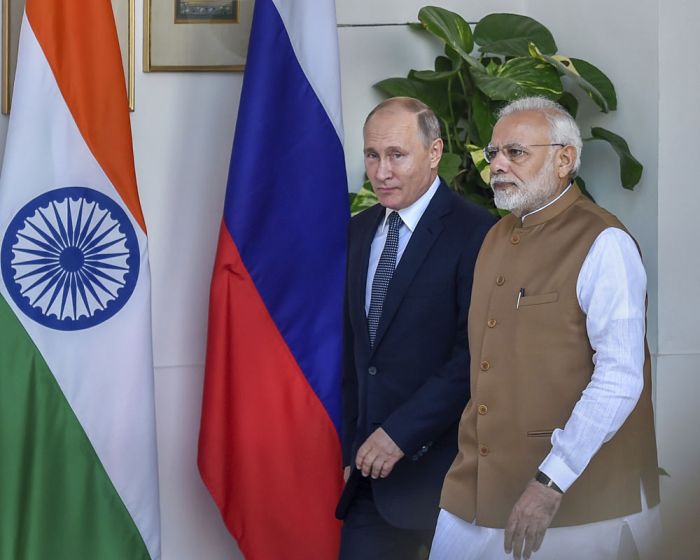
New Delhi: India and Russia on Friday firmed up a five-year plan to bolster economic and trade ties in the face of Washington’s punitive tariff and sanctions regime even as Prime Minister Narendra Modi conveyed to President Vladimir Putin that the war in Ukraine must be brought to an end through peaceful means.
Following their summit talks that generated global attention, Modi and Putin demonstrated their keenness to impart a fresh momentum to the over eight-decades-old India-Russia friendship with the prime minister saying that it remained steadfast like a “pole star” notwithstanding geopolitical churn.
Besides finalising the 2030 economic programme, the two sides signed several agreements to expand cooperation in a number of sectors including health, mobility and migration, food safety, shipping and people-to-people exchange.
The Russian president landed in New Delhi last evening to a red-carpet welcome with Modi personally receiving him at the airport and later hosting a private dinner for him that largely set the tone for the 23rd India-Russia annual summit.
The visit has generated attention in the capitals of the Western nations as it has come amid their sustained efforts to hit Moscow economically including by cutting Russian crude oil supplies as part of initiatives to force it to end the war in Ukraine.
“The world has witnessed many ups and downs over the past eight decades. Humanity has faced numerous challenges and crises. And through all this, the India-Russia friendship has remained like a pole star,” Modi said in his media statement.
“This relationship, built on mutual respect and deep trust, has always stood the test of time. Today, we discussed all aspects of cooperation to further strengthen this foundation. Taking economic cooperation to new heights is our shared priority,” he added.
To achieve this, Modi said that the two sides agreed on an economic cooperation programme until 2030 and it will make bilateral trade and investment diversified, balanced, and sustainable.
The prime minister also announced that India will soon introduce a free 30-day e-tourist visa and a 30-day group tourist visa for Russian citizens.
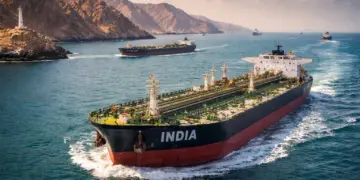
In his comments, Putin said both sides are looking at increasing the volume of annual trade to USD 100 billion from the present USD 64 billion and that Russia is a “reliable supplier of oil, gas, coal and everything that is required” to address India’s energy requirement.
“Russia is ready to continue uninterrupted shipments of fuel for the fast-growing Indian economy.”
The Russian president indicated that Moscow will provide more market access for Indian products and that both sides are keen on cooperation for construction of small and modular nuclear reactors and floating nuclear power plants.
He said Russia could also extend help to India in non-energy application of nuclear technologies, for example in medicine and agriculture.
In his comments, Modi said energy security has been a strong and an important pillar of the India-Russia partnership and that the cooperation in the field of civil nuclear energy has been crucial. “We will continue this win-win cooperation.”
“Our cooperation in critical minerals is crucial to ensuring secure and diversified supply chains around the world. This will provide solid support to our partnerships in clean energy, high-tech manufacturing, and new-age industries,” he said.
The Ukraine conflict also figured prominently in the talks with Modi saying that India has advocated for peace in that country.
“We welcome all efforts for a peaceful and lasting solution to this issue. India has always been ready to contribute and will continue to do so,” he said.
Ways to effectively combat terrorism also figured in the Modi-Putin talks.
“India and Russia have long cooperated shoulder-to-shoulder in the fight against terrorism. Be it the terrorist attack in Pahalgam or the cowardly attack on Crocus City Hall — the root of all these incidents is the same,” Modi said.
“India firmly believes that terrorism is a direct attack on the values of humanity and that global unity against it is our greatest strength,” he added.
Modi said enhancing connectivity between the two countries is a key priority.
“We will move forward with renewed energy on the INSTC, Northern Sea Route, and Chennai-Vladivostok Corridors. I am delighted that we will now collaborate to train Indian seafarers in polar waters,” he said.
“This will not only strengthen our cooperation in the Arctic but will also create new employment opportunities for India’s youth,” he said.
The International North South Transport Corridor (INSTC) is a 7,200-km-long multi-mode transport project for moving freight among India, Iran, Afghanistan, Armenia, Azerbaijan, Russia, Central Asia and Europe.
The prime minister said the deep cooperation between the two sides in shipbuilding has the potential to strengthen the Make in India programme.
He also showered praise on Putin for his “unwavering commitment” in strengthening India-Russia ties.
“For the past two and a half decades, he has nurtured these ties with his leadership and vision. His leadership has taken our relations to new heights under all circumstances.”
The prime minister also made a mention of two pacts sealed to facilitate mobility of manpower between the two countries.
“Manpower mobility will connect our peoples and create new strengths and opportunities for both countries. I am pleased that two agreements have been signed today to promote this,” he said.
In his media statement, Putin said the two sides resolved to prioritise cooperation in areas of security, economy, trade and culture.
We are looking at increasing annual bilateral trade volume to USD 100 billion, he said.
Putin said Russia is also looking at expanding cooperation in the energy sector with New Delhi, adding his country is ready for uninterrupted shipments of fuel to India.
We could also talk about cooperation in construction of small modular nuclear reactors and floating nuclear power plants, he said.
Russia, India and other like-minded nations are working towards a just and multipolar world, Putin noted.