
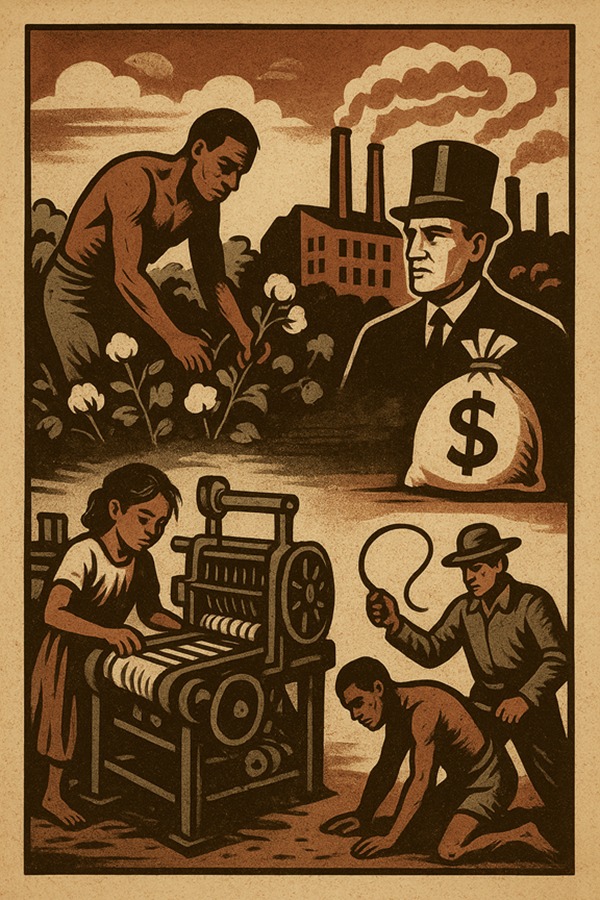
When we talk about capitalism today, we often think of markets, industries, banks, and global trade. What is less acknowledged is that the roots of this system were deeply connected to slavery. During the 19th and even into the 20th century, slavery was not just a moral crime; it was an economic engine that helped build the modern world.
The Industrial Revolution Was Built on Slave-Produced Cotton:
In the 1800s, the global economy revolved around cotton. By the middle of the century, the American South supplied almost 80 percent of the world’s cotton, grown almost entirely by enslaved African Americans. This cotton powered the textile mills of Britain, France, and the northern United States; industries that were at the heart of the Industrial Revolution. These factories created massive profits and jobs, but their success depended on the brutal exploitation of enslaved labourers thousands of miles away.
The brutality that slaves endured was unimaginable. Children as young as five were forced to work in cotton factories because industrialists found them obedient and easy to manage. Their small hands could reach into the deepest corners of machines to repair broken looms, making them especially valuable and especially vulnerable. They worked more than fourteen hours a day, often without rest. To meet the rising demand for labour, enslaved women were pressured and often violently forced to bear more children, or else faced savage punishment. Slaves who failed to meet daily targets were beaten or tortured as an example to others, and any attempt to escape these farms or factories often meant certain death. This cruelty was not accidental; it was built into the economic system, ensuring a steady supply of labour for factories and plantations.
Banks, insurance companies, and shipping firms also grew rich from this system. Enslaved people were treated as financial assets. They could be bought, sold, insured, loaned against, and written into accounting books. This financial structure became the early model for the corporate practices we see today.
After Abolition, New Systems of Forced Labour Replaced Old Ones:
Even after slavery was legally abolished, the economic dependence on cheap, coerced labour did not disappear. It simply took new forms.
In the U.S. South, freed African Americans were pushed into sharecropping, a system that kept them tied to landowners through unpayable debts. Cotton production continued, but those who worked the land remained trapped in poverty and exploitation.
Another form of forced labour emerged through “convict leasing.” Black men were arrested on minor or fabricated charges, imprisoned, and then leased out to private companies in railroads, mining, and agriculture. They were unpaid, unprotected, and easily replaced. This system powered industrial development in the American South well into the 20th century.
Colonialism Spread Forced Labour Across the World:
European colonial powers used similar systems across Africa, Asia, and the Caribbean. Millions of people were forced to work to extract rubber, cocoa, sugar, palm oil, and minerals; all to supply industries in Europe and North America. These raw materials were essential for manufacturing, but the people who produced them received almost nothing in return.
Indentured labour systems also emerged in places like the Caribbean, India, Southeast Asia, and Latin America. Workers were bound by contracts, debts, or company-controlled towns. Once again, the profits flowed to investors and corporations, not the labourers.
A World Economy Built on Inequality:
The profits of slavery and forced labour did not stay local. They flowed into Western banks, factories, shipping companies, and governments. This early wealth helped build modern financial institutions, industrial corporations, and global trade networks. Meanwhile, the regions that supplied the labour, whether plantations in the American South or colonies in Africa, were left with poverty, underdevelopment, and social inequality.
This imbalance shaped the modern world. The divide between rich and poor nations, and between wealthy investors and exploited workers, can be traced back to these systems.
The Legacy of Slavery in Today’s Capitalism:
Slavery officially ended, but its logic survived. The drive to cut labour costs, control workers, and maximize profit continues to guide global industries. Wage gaps, exploitative supply chains, and racial inequalities in wealth and opportunity are all part of this legacy. For example, we notice unequal
In many ways, modern capitalism still carries the imprint of the plantation; a system built on extreme control, low labour costs, and high profits for a few.
Conclusion:
Slavery was not a side story in the history of capitalism. It was its foundation. It provided the raw materials, wealth, financial structures, and management practices that built the modern global economy. Understanding this history helps us see why economic inequality, between countries and within societies, remains so deep today.