
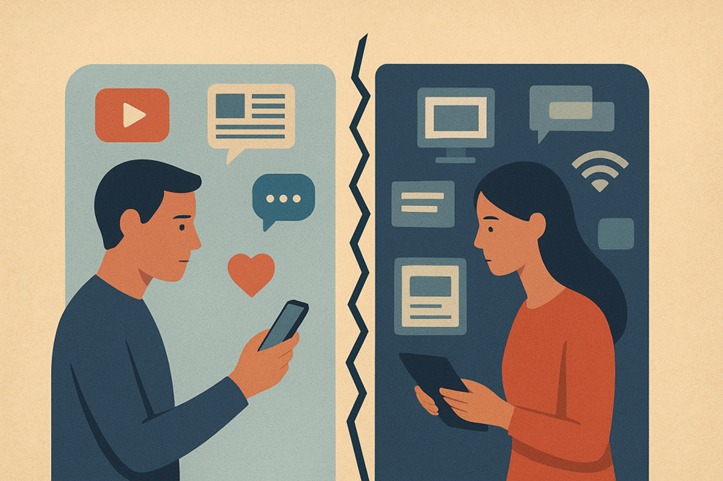
In today’s hyperconnected world, humanity faces an invisible but growing separation, a divided reality. Artificial intelligence (AI) now determines much of what we see, hear, and believe. It personalizes our digital experiences to such a degree that people live inside self-curated bubbles, where familiar opinions echo back and challenging truths fade away. The result is confusion, polarization, and a shrinking sense of shared understanding.
Living in two worlds:
We now inhabit two parallel worlds: the physical and the digital. Yet, the physical one, the realm of face-to-face conversations, real communities, and tangible experiences, is shrinking fast. Our work, education, relationships, and entertainment increasingly unfold online. This shift is steering society toward a future where the digital world feels more real than reality itself.
The power, and peril, of algorithms:
AI algorithms on social media platforms and search engines continuously study our behaviour, every click, share, and search. Their goal is simple: to keep us engaged. But in doing so, they construct what researchers call “filter bubbles” or “echo chambers”, where people are exposed only to information that confirms their existing beliefs.
This algorithmic filtering creates a narrow and self-reinforcing view of the world. Over time, it intensifies confirmation bias, encouraging users to reject differing opinions and distrust those who think differently. As a result, critical thinking erodes. When people are consistently fed a one-sided version of reality, they lose the habit, and sometimes even the ability, to question, reflect, and engage with complexity.
The digital divide:
Beyond the bubble lies another barrier: the digital divide. This refers to the gap between those who have access to modern technology and those who do not. It’s not just about devices or connectivity; it’s also about opportunity.
Access and affordability remain key obstacles. Millions of people still lack reliable internet connections or cannot afford smartphones, laptops, or computers. Rural and remote communities, especially in developing regions, often have little or no access to digital infrastructure. Even when technology is available, many lack the digital literacy to use it effectively, a gap most visible between younger generations and older adults.
This divide deepens existing inequalities. Those without digital access face disadvantages in education, employment, healthcare, and civic participation. In essence, digital exclusion becomes social exclusion.
Who owns our reality:
A few powerful corporations, Google, Meta (Facebook, Instagram, WhatsApp), X (formerly Twitter), Amazon, WeChat, Douyin, and Weibo, control the digital landscape. They collect immense amounts of personal data, analysing habits, emotions, and beliefs. This data is then used to shape what we see, what we think, and even how we vote.
The question is no longer who owns the technology, but who owns the truth.
Tech companies are more powerful than nations:
Some technology companies now earn more money than entire countries. Their influence is not just economic, it is political. World leaders and governments often work closely with these corporations to gain or maintain power. As a result, business, politics, and technology have become deeply intertwined.
For example, Nvidia recently touched a $5 trillion market value, surpassing the Gross Domestic Products (GDPs) of both India and Japan. It now exceeds the GDPs of virtually all nations except the United States, China, and Germany. This milestone highlights the staggering concentration of power and wealth in the hands of a few technology giants, entities that now rival, and in some cases surpass, the influence of nation-states.
A grim example: When AI fuelled genocide:
The consequences of unchecked algorithms can be devastating. A tragic example is the Rohingya genocide in Myanmar. United Nations investigators found that Facebook played a central role in spreading hate speech and misinformation against the Rohingya Muslim minority.
Meta’s algorithms, designed to promote high-engagement content, amplified posts that triggered strong emotional reactions. In Myanmar, this meant hateful and incendiary messages went viral, fuelling violence that led to a brutal military crackdown in 2017. Over 700,000 Rohingya were forced to flee to Bangladesh. Lawsuits against Meta claim the platform’s design actively encouraged this outcome by prioritizing engagement over ethics.
Bridging the divide:
Addressing the twin crises of algorithmic manipulation and digital inequality is essential for building a fair and united society. But doing so requires accountability.
Corporations often claim they bear no moral responsibility for how their platforms are used, focusing instead on their fiduciary duty to shareholders. This is a dangerous abdication. In truth, these companies must be held legally and ethically responsible for regulating the algorithms that shape public opinion and social behaviour.
Society cannot rely solely on individual users to navigate complex digital systems. The responsibility must rest with those who profit from them.
A call for accountability:
Technology can empower humanity, but only if guided by transparency, fairness, and shared responsibility. Bridging the digital divide and curbing algorithmic abuse are not just technical challenges; they are moral imperatives.
If we fail to act, the gap between our digital selves and our physical lives will continue to widen, until reality itself becomes the greatest casualty of the digital age.
– The author has over 25 years of working experience with leading semiconductor MNCs.