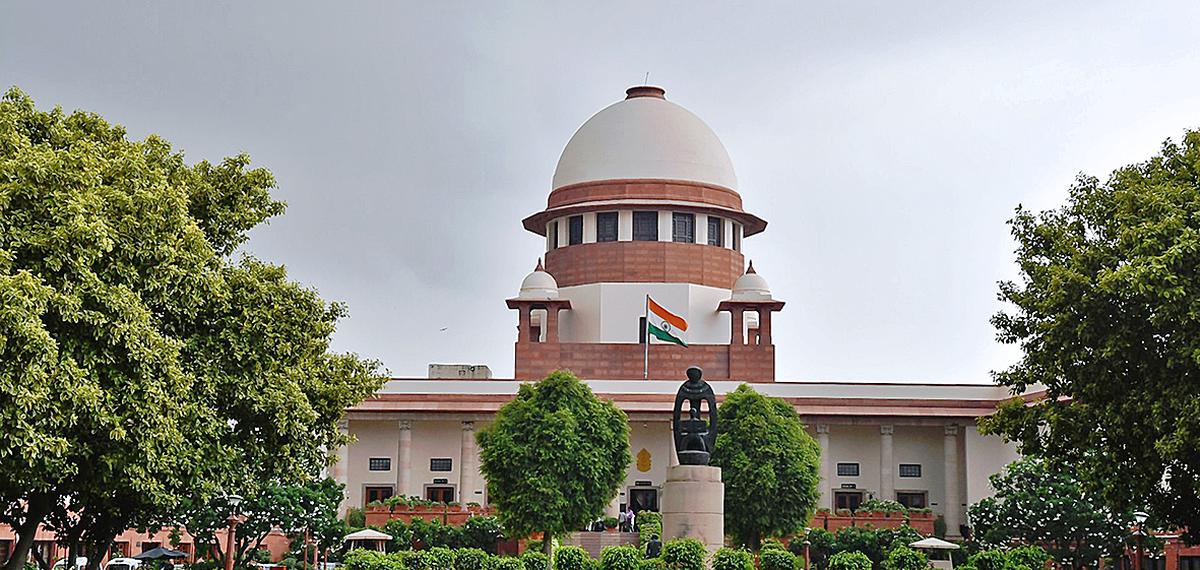
New Delhi: In a major jolt to the Centre, the Supreme Court on Wednesday struck down key provisions of the 2021 Tribunals Reforms law related to appointment, tenure, and service conditions of tribunal members and presiding officers, saying “Parliament cannot simply override judicial decision by reenacting” these with minor tweaks.
The top court made scathing remarks against the Centre for bringing back the same provisions of the ordinance in the law.
“We must express our disapproval of the manner in which the Union of India has repeatedly chosen to not accept the directions of this court on the very issues that have already been conclusively settled through a series of judgements.
“It is indeed unfortunate that instead of giving effect to the well-established principles laid down by this court on the question of the independence and functioning of tribunals, the legislature has chosen to reenact or re-introduce provisions that reopen the same constitutional debates under different enactments and rules,” a bench comprising Chief Justice B R Gavai and Justice K Vinod Chandran said in its 137-page judgement.
It allowed the plea of the Madras Bar Association and others against the law and invalidated several contentious provisions including the one which prescribed a minimum age of 50 years for appointments in tribunals.
It also set aside the fixed tenure of four years for chairpersons and members and the mandate for the Search-cum-Selection Committee (SCSC) to recommend a panel of two names for each vacancy, which was seen as giving the executive undue discretion.
“Stability of tenure and protection of vested rights are essential components of judicial independence, and the court’s earlier directions on this subject cannot be lightly departed from,” the CJI said.
Writing the judgement for the bench, the CJI said the Act stands on two identical, already rejected premises.
“It reproduces the substance of provisions invalidated in the earlier litigations without curing the defects, and it rests on constitutional arguments that the court has already expressly disapproved,” the verdict said.
Justice Chandran endorsed the views of the CJI and said, “The Tribunal Reforms Act, 2021 is a replica of the struck down Ordinance; old wine in a new bottle, the wine whets not the judicial palette, but the bottle merely dazzle”.
The CJI said once the court struck down a provision after identifying a constitutional defect, “Parliament cannot simply override or contradict that judicial decision by reenacting the very same measure in a different form”.
What Parliament may legitimately do is to cure the defect identified by the court, whether by altering the underlying conditions, removing the constitutional infirmity, or restructuring the statutory framework in a manner consistent with the court’s reasoning, it said.
The verdict said the judicial system is already burdened with a staggering pendency across all the courts.
The responsibility of reducing pendency in courts does not rest only on the judiciary, it said, adding “It is a shared institutional duty. While the judiciary must strive to enhance efficiency in case management and decision-making, the other branches of government must exercise their legislative and executive powers with due regard to constitutional principles and judicial precedent.”
“Respect for settled law is as essential to good governance as it is to judicial discipline…It ensures that institutional time is spent in advancing justice rather than revisiting questions long resolved,” it said.
The bench said Parliament can bring a law unless the concerns highlighted by it in a series of tribunal related judgments are fully addressed and cured.
The bench directed the Centre to establish a National Tribunals Commission and said it is an essential structural safeguard designed to ensure independence, transparency, and uniformity in the appointment, administration, and functioning of tribunals across the country.
“We grant the Union of India a period of four months from the date of this judgment to establish a National Tribunals Commission. The commission so constituted must adhere to the principles articulated by this Court, particularly concerning independence from executive control, professional expertise, transparent processes, and oversight mechanisms that reinforce public confidence in the system,” it said.
It clarified that appointments done before the commencement of the Tribunal Reforms Act, 2021, but whose formal appointment notifications were issued after the Act came into force, shall be protected.
On November 11, the bench had reserved its verdict on a batch of petitions challenging the constitutional validity of the Tribunals Reforms (Rationalisation and Conditions of Service) Act, 2021.
The Act replaced the earlier Tribunals Reforms (Rationalisation and Conditions of Service) Ordinance, 2021, which had drawn similar constitutional challenges.
The top court had struck down the provision of the ordinance that reduced the tenure of Tribunal members and chairpersons to four years, noting that a short term of office could encourage executive influence over the judiciary.
The ordinance was promulgated in April 2021.
After the apex court verdict, the government in August introduced and passed the Tribunals Reforms Act with provisions almost identical to those that were struck down.