November 07 marked the 150th anniversary of India’s National Song Vande Mataram, which reads “Mother, I Bow to Thee”. Originally written by Bankim Chandra Chatterjee, the lyrics were first published in Bangadarshan in November 1875. The song was then included in novel Anandamath (1882) and set to music by noted figure Rabindranath Tagore during the Indian National Congress session in 1896.
Throughout these years, the song has played a central role in India’s freedom movement and continues to hold national importance even today.
On 16 April 1907, Sri Aurobindo accepted that this song had been written 32 years earlier. Before appearing in book form, Anandamath was serialized in Bangadarshan magazine in 1881, with the song printed in the first installment.
At the onset of the Swadeshi movement in 1905, the song was used as a political slogan across Bengal. Madam Bhikaji Cama famously raised India’s tricolour flag in Stuttgart, with the words Vande Mataram inscribed on it.
As visualized in Anandamath, a group of monks called Santanas who are known to have dedicated their lives to their motherland. They worship the country as a mother figure. In their temple, three images represent the motherland in the form of the glorious past, the suffering present, and the hopeful future.
Sri Aurobindo described this as a vision of strength and self-reliance. Through this idea, Bankim Chandra Chatterjee has presented patriotism of a motherland as a form of devotion.
Legacy of Chatterjee
Bankim Chandra Chatterjee (1838–1894) was a novelist, poet, and essayist. He was one of the key literary figures of 19th-century Bengal. His celebrated works include Durgeshnandini (1865), Kapalkundala (1866), Anandamath (1882), and Devi Chaudhurani (1884).
Vande Mataram is deemed to be his major contribution to the early nationalist thought in primitive India.
Through his writings, Bankim Chandra has promoted the idea of the motherland as the unifying force for the people. In October 1905, the Bande Mataram Sampradaya was formed in North Calcutta. Members sang Vande Mataram during morning processions known as Prabhat Pheris, and Rabindranath Tagore sometimes joined them.
In May 1906, as many as 10,000 people joined a Vande Mataram procession in Barisal (now in Bangladesh). In August 1906, the daily newspaper Bande Mataram was started by Bipin Chandra Pal, later joined by Sri Aurobindo. The paper spread the message of self-reliance and national unity.
The British government has reportedly tried to restrict and censor the song. Britishers have issued circulars banning the song across schools and colleges. Students were fined or threatened with expulsion for chanting Vande Mataram by the then authorities. Despite immense restrictions imposed on the people, the song has spread across India and has emerged as protest song.
Symbol of Resistance
Between 1905 and 1908, Vande Mataram was seen as a slogan of protest in India. Commonly it was sung at key public meetings, demonstrations, and gatherings in Bengal, Maharashtra, Punjab, and Tamil Nadu.
For instance in Barisal (in April 1906), British authorities banned the chant at a provincial conference. Later on protesters raised the slogan against the arrest of leaders in Lahore in 1907.
Another example would be during the mill workers march at Tuticorin in February 1908, wherein they chanted Vande Mataram during a strike. Likewsie in Bombay in 1908, crowds sang the song outside the court during Lokmanya Tilak’s trial on June 21. The footprints of this protest song have resonated outside India as well. Vande Mataram has undoubtedly inspired a large list of freedom activists internationally.
Impact of the song
In 1907, Madam Bhikaji Cama raised the flag in Stuttgart, Berlin. The words Vande Mataram were written on the flag. In 1909, Madan Lal Dhingra’s last words before execution were Bande Mataram. The same year, Indian patriots in Paris published a magazine titled Bande Mataram. In 1912, when Gopal Krishna Gokhale reached South Africa, the crowd welcomed him with cries of Vande Mataram.
During the Constituent Assembly discussions in 1950, members agreed to give equal respect to Vande Mataram and Jana Gana Mana.
On 24 January 1950, Dr. Rajendra Prasad stated: “The song Vande Mataram, which has played a historic part in the struggle for Indian freedom, shall be honoured equally with Jana Gana Mana and shall have equal status with it.”
This statement made Vande Mataram the National Song of India, with equal status to the National Anthem.
Commemorating 150 Years
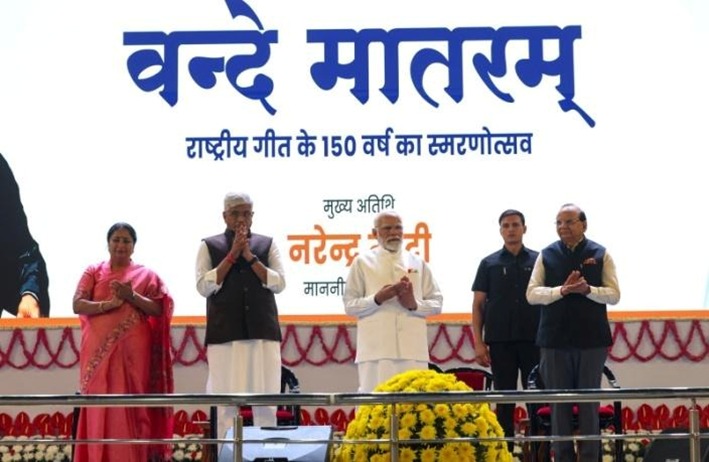
This November, the government of India’s decision to mark the 150th anniversary of Vande Mataram through yearlong events underscores the song’s enduring significance in India’s cultural and political history. The present observance not only reaffirms the enduring relevance of Bankim Chandra Chattopadhyay’s vision but also invites renewed reflection on the song’s role in shaping the discourse of nationalism, unity, and cultural self-awareness in modern India.
Beginning with the inaugural celebration at New Delhi’s Indira Gandhi Stadium on November 7, the commemorations extend to the tehsil level, featuring commemorative stamps, exhibitions, musical performances, and documentation projects. These efforts aim to renew public engagement with a song that has long symbolized India’s struggle for freedom and collective identity.
The wider programme which will be spanning radio shows, global music festivals, and tree plantation drives under “Salute to Mother Earth” seeks to integrate patriotism with civic and cultural life.
Today, as millions of Indian across the political and religious spectrum revisits Bankim Chandra Chatterjee’s composition the real struggle lies in keeping the commemoration inclusive and reflective of the nation’s diversity. The 150th year anniversary is therefore an occasion to honor its legacy while reimagining its message of nationalism, unity, and cultural self-awareness in modern India.

Courtesy: PIB Srinagar