Islamic architecture is not just a style—it is a philosophy rendered in stone, light, and silence. Born in the 7th century with the rise of Islam, it evolved as a living language of faith and harmony, blending Persian, Byzantine, Central Asian, and Indian traditions into an architecture that speaks to both the eye and the soul. Its essence lies not merely in grandeur, but in the spiritual rhythm that connects geometry, balance, and the divine. Every arch, dome, and courtyard is more than a structure—it is a prayer carved in space.
At its core, Islamic architecture reflects Tawhid, the oneness of God. Instead of representing the divine through figures or images, it turns to abstraction—intricate patterns, flowing calligraphy, and geometric perfection. These forms, endlessly repeating yet perfectly ordered, mirror the infinite and harmonious nature of creation. Light plays a sacred role, filtering through screens of stone or glass, illuminating verses of the Qur’an, and turning the interior into a space of moving meditation. Sound, too, is part of the design—the echo of prayer beneath a dome becomes a dialogue between the believer and the divine.
The mosque, the heart of Islamic design, embodies this spirit of unity. From the serene courtyards of Damascus and the grand arches of Córdoba to the blue-tiled splendor of Isfahan, the mosque is both a house of worship and a center of learning, culture, and community. The mihrab marks the direction of Mecca, uniting millions of worshippers worldwide in one orientation of faith. The minaret, slender and elegant, calls the faithful to prayer, while the dome, rising above, symbolizes the heavens, creating a sense of peace beneath its celestial curve.
Decoration in Islamic architecture is never superficial—it is spiritual. The arabesque’s endless vines express the divine order within natural forms; geometry reveals the logic of the cosmos; calligraphy transforms sacred words into flowing ornamentation. Walls become pages, surfaces become meditations, and space becomes a bridge between intellect and emotion. To walk through an Islamic structure is to walk through thought made visible—a harmony of precision and poetry.
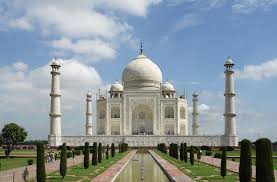
In India among many Islamic architectural marvellous we have Taj Mahal, winner of the New 7 Wonders of the World initiative. The Taj Mahal was designated as a UNESCO World Heritage Site in 1983 for being “the jewel of Islamic art in India and one of the universally admired masterpieces of the world’s heritage”. It is regarded as one of the best examples of Mughal architecture and a symbol of Indian history. The Taj Mahal was built in the 17th century by Emperor Shah Jahan in memory of his beloved wife Mumtaz Mahal. It transcends the definition of a mausoleum—it is love eternal, given form in marble. Its perfect symmetry, delicate carvings, and ethereal white glow at dawn and dusk transform stone into emotion. The central dome, surrounded by four slender minarets, seems to float like a prayer suspended between earth and sky. Every inch of its surface is adorned with calligraphy, floral inlays, and geometric precision, yet its overall impression is one of simplicity and calm. The gardens, divided by flowing water channels, echo the Qur’anic description of paradise—a place of eternal peace and beauty. In the Taj Mahal, faith, art, and emotion merge seamlessly, creating not just a monument but a meditation on love, time, and the eternal.
In a world of fleeting designs and changing fashions, Islamic architecture endures as a language of permanence and peace. It teaches that the sacred can be found in proportion, that geometry can become prayer, and that the physical world, when shaped with reverence, can mirror the divine order. The marble of the Taj Mahal, the , and the arches of Córdoba all whisper the same truth—that architecture, when guided by faith and love, becomes not only a shelter for the body, but also a sanctuary for the soul.