• About us
  • Contact us
  • Our team
  • Terms of Service
Wednesday, April 1, 2026
Kashmir Images - Latest News Update
Epaper
  • TOP NEWS
  • CITY & TOWNS
  • LOCAL
  • BUSINESS
  • NATION
  • WORLD
  • SPORTS
  • OPINION
    • EDITORIAL
    • ON HERITAGE
    • CREATIVE BEATS
    • INTERALIA
    • WIDE ANGLE
    • OTHER VIEW
    • ART SPACE
  • Photo Gallery
  • CARTOON
  • EPAPER
No Result
View All Result
Kashmir Images - Latest News Update
No Result
View All Result
Home ART SPACE

Integration of Art and Paintings in Primary Education

Dilshada Akhter by Dilshada Akhter
September 6, 2025
in ART SPACE
A A
0
Integration of Art and Paintings in Primary Education
FacebookTwitterWhatsapp

Education in the early years is not only about teaching children how to read, write, and count; it is about shaping young minds to think creatively, feel deeply, and express themselves freely. In this journey, art and paintings play a role that is often underestimated but deeply transformative.

For a child, a brush dipped in color is more than just a tool—it is a voice. Through paintings and drawings, children learn to express feelings they cannot yet put into words. A simple picture of a house, a tree, or even the sky reflects their imagination, their understanding of the world, and sometimes even their hidden emotions. Art, therefore, is not a luxury in education; it is a necessity.

More News

A Critical Review of Ganj-e-Gohar, Haji Ramzan’s Spiritual and Literary Masterpiece

Grudges

When Walls Begin to Teach: A New Learning Tool in our schools

Load More

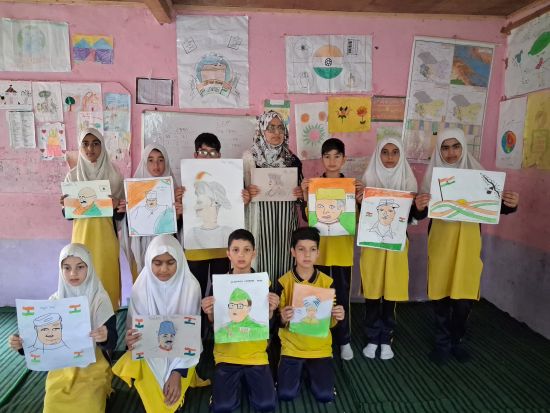
Integrating art into primary education has multiple benefits. It strengthens memory, improves concentration, and helps children understand difficult concepts in easier ways. A lesson in mathematics becomes more enjoyable when symmetry is explained through drawings, while a science topic like “parts of a plant” comes alive when children illustrate it with colors. Art makes learning joyful, and joyful learning is lasting learning.

Beyond academics, art nurtures empathy, patience, and cultural awareness. When children are introduced to paintings from different traditions, they learn respect for diversity and pride in their own heritage. In a region like Kashmir, rich with its own artistic traditions, integrating local art forms in schools can help children connect with their culture while preparing them to be global citizens.

However, the reality in many schools is different. Due to limited resources, rigid curricula, and the pressure of examinations, art often gets pushed aside as an “extra activity.” Teachers too may feel unprepared to teach art meaningfully. Yet, small steps can bring big changes. A simple initiative like dedicating one class a week to painting, using local art materials, or organizing art exhibitions in schools can spark a culture of creativity.

The integration of art is not only about developing future painters or artists. It is about building well-rounded human beings who can think critically, solve problems creatively, and express themselves confidently. In today’s world, where innovation is valued more than rote knowledge, these are the very skills that children need most.

As educators, parents, and policymakers, we must realize that art is not separate from education—it is education itself. Just as a flower cannot bloom without sunlight, a child cannot grow fully without the colors of creativity. Integrating art and paintings into primary education is, therefore, not an option but a responsibility.

If we wish to see our classrooms filled with curiosity, imagination, and joy, then it is time to give children the freedom of colors, brushes, and canvases. Through art, we can nurture not only better learners but also better human beings.


The writer can be reached at dilshadaakhter9999@gmail.com
Previous Post

IT’S MY FACE!!

Next Post

Cartoon

Dilshada Akhter

Dilshada Akhter

Related Posts

A Critical Review of Ganj-e-Gohar, Haji Ramzan’s Spiritual and Literary Masterpiece

A Critical Review of Ganj-e-Gohar, Haji Ramzan’s Spiritual and Literary Masterpiece
March 28, 2026

The history of Kashmiri literature date back to the past few centuries, maintaining the consciousness, emotions, and cultural essence of...

Read moreDetails

Grudges

Regional-bilateral significance of Nepal PM Dahal’s India visit
March 28, 2026

Grudges are a waste of perfect happiness. So often we hold on to some biting remark, or a nasty, backstabbing...

Read moreDetails

When Walls Begin to Teach: A New Learning Tool in our schools

When Walls Begin to Teach: A New Learning Tool in our schools
March 14, 2026

In many schools across India, the walls are no longer silent. They speak through numbers, maps, alphabets, and colorful diagrams...

Read moreDetails

The Politics of Satire: The Trump–Epstein Statue and the Message of “Secret Handshake”

The Politics of Satire: The Trump–Epstein Statue and the Message of “Secret Handshake”
March 14, 2026

Artists have always used their art as a tool to create a debate on highly sensitive political issues as well...

Read moreDetails

Gloating In Vain By Lily Swarn 

Regional-bilateral significance of Nepal PM Dahal’s India visit
March 14, 2026

   Many are the times, when my ego, stutters and stammers between gloating, self -aggrandizement and pitiful morbidity. Often, I...

Read moreDetails

Kashmir

Kashmir
March 7, 2026

Born on 13 March 1866, Edward Mary Joseph Molyneux was a British officer whose lasting legacy rests on his artistic...

Read moreDetails
Next Post
Cartoon

Cartoon

  • About us
  • Contact us
  • Our team
  • Terms of Service
E-Mailus: kashmirimages123@gmail.com

© 2025 Kashmir Images - Designed by GITS.

No Result
View All Result
  • TOP NEWS
  • CITY & TOWNS
  • LOCAL
  • BUSINESS
  • NATION
  • WORLD
  • SPORTS
  • OPINION
    • EDITORIAL
    • ON HERITAGE
    • CREATIVE BEATS
    • INTERALIA
    • WIDE ANGLE
    • OTHER VIEW
    • ART SPACE
  • Photo Gallery
  • CARTOON
  • EPAPER

© 2025 Kashmir Images - Designed by GITS.