New Delhi: Weeks before top BRICS leaders converge in Rio de Janeiro for summit talks, envoys of leading member nations of the grouping hinted that it could focus on greater use of national currencies for trade in the face of uncertainties over Trump administration’s aggressive policy on tariff.
Russian Ambassador Denis Alipov reaffirmed Moscow’s strong support for trade in local currency among BRICS member nations and described the grouping as “a serious platform for discussing joint solutions to big challenges”.
The summit is unlikely to make any significant progress on the proposed BRICS currency as it will need significant structural changes and reforms. In the last few months, President Donald Trump has cautioned BRICS member nations against rolling out a BRICS currency to replace the US dollar.
“BRICS is not a counter-bloc. It is a centre of gravity for countries seeking mutual respect and non-interference,” Alipov said at a conference titled “BRICS in Rio: Shaping an Inclusive and Sustainable World Order” on Friday evening that was co-organised by the Embassy of Brazil in India and Centre for Global India Insights (CGII), a leading think tank focused on global affairs.
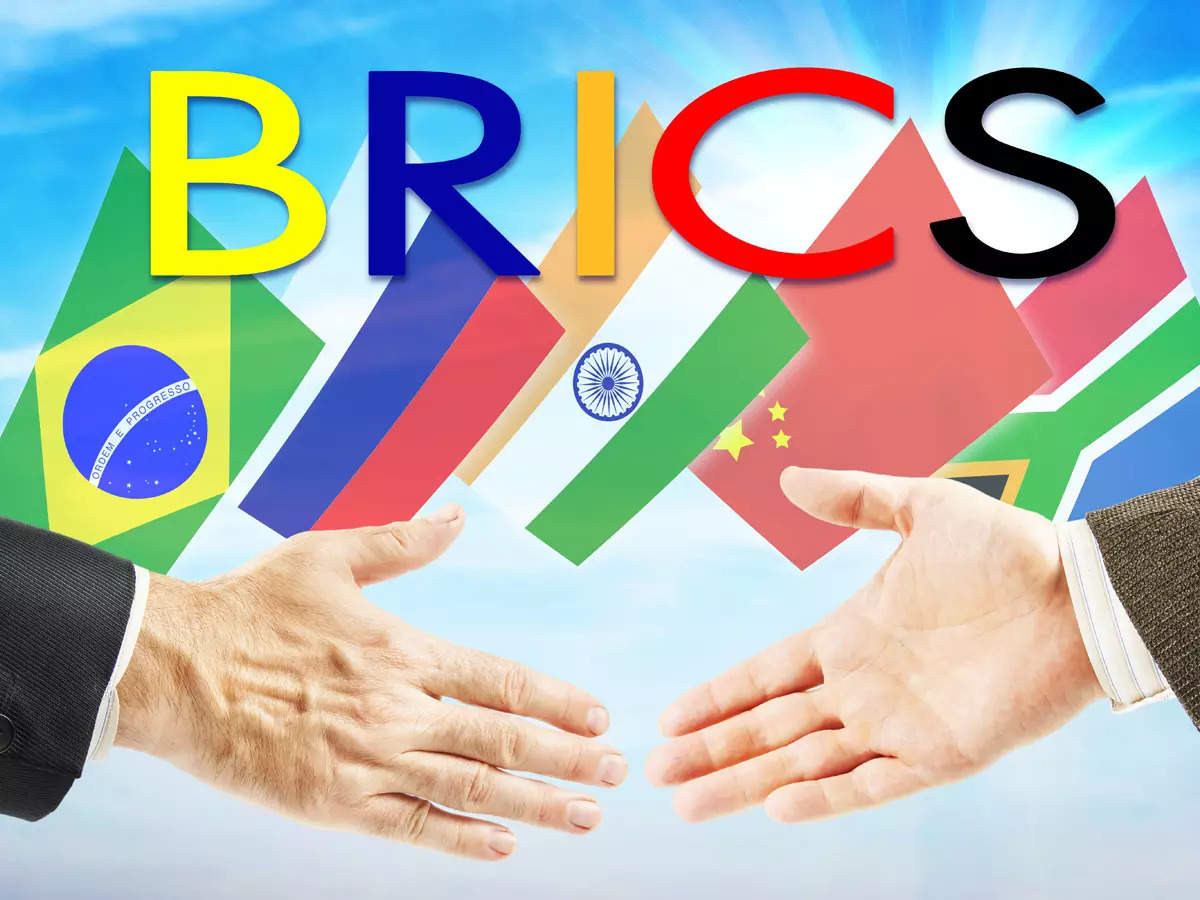
The 17th BRICS ((Brazil, Russia, India, China, and South Africa) summit will be held in Rio de Janeiro on July 6 and 7. Brazil is hosting the summit in its capacity as the chair of the influential bloc.
Prime Minister Narendra Modi, Chinese President Xi Jinping, South African President Cyril Ramaphosa and several other leaders of the member nations of the grouping are expected to attend the summit.
Enhancing the use of national currencies in settling intra-BRICS trade figured prominently in discussions, with all panellists backing the proposal, which is already being implemented by BRICS countries.
However, the panellists found the idea of a BRICS common currency impractical.
Besides Alipov, India’s BRICS sherpa and Secretary (Economic Relations) in the Ministry of External Affairs (MEA) Dammu Ravi, Brazil’s Ambassador to India Kenneth Felix Haczynski da Nobrega, Indonesia Ambassador Ina Hagniningtyas Krisnamurthi and Egypt’s envoy Kamel Zayed Kamel Galal attended the conference.
In his remarks, Ravi clarified that discussions around a BRICS common currency are still at a very early stage.
“Today, for now, we are only looking at trade settlement in national currencies. Harmonisation of fiscal and monetary policies is very, very difficult to achieve, he said.
Nobrega and Ravi both reiterated that a common currency would require far deeper policy harmonisation — something the EU struggled with despite far more economic alignment.
“It’s a long way,” said Nobrega. “But trading in local currencies? That’s already working.”
In his remarks, Alipov emphasised that BRICS is not an anti-West alliance but a platform of sovereign equals.
“BRICS is not a counter-bloc. It is a centre of gravity for countries seeking mutual respect and non-interference,” he said. The grouping, he added, is evolving into a “more comprehensive and more representative” platform with its latest round of expansion.
BRICS, originally comprising Brazil, Russia, India, China, and South Africa, expanded in 2024 to include Egypt, Ethiopia, Iran, and the United Arab Emirates, with Indonesia joining in 2025.
Among the new members, Ambassador Ina Krisnamurthi of Indonesia made a powerful case for systemic reform.
“Our international order, the rules-based system, is crashing into the limits of its founding vision,” she said.
“Multilateral institutions have failed to address the adverse impacts of recent challenges,” the ambassador said.
Indonesia’s inclusion in BRICS, she noted, aligns fully with its foundational non-aligned foreign policy.
She laid out Indonesia’s core priorities: better representation, swifter decision-making and stronger accountability.
“Right now, the Global South represents 85 per cent of the world’s population and 39 per cent of global GDP,” Krisnamurthi said, pointing to demographic and economic shifts.
“Yet multilateral institutions do not reflect this reality.”
Citing the combined middle-class surge across China, India, and ASEAN, she noted: “In 2000, only 150 million enjoyed middle-class living standards. Today, that number is 1.5 billion — double the total population of Western countries.”
For BRICS to succeed, she added, it must be “not just dialogue but delivery”, especially in areas of climate finance, humanitarian relief and data equity.
Egypt’s envoy to India brought both clarity and conviction to the table. Despite Egypt’s recent formal entry into BRICS, he stressed that “Egypt has always viewed itself as a natural member of BRICS since the group’s inception.”
He outlined Cairo’s vision for the upcoming Rio summit: “We are keen that the group should focus on areas of cooperation that enjoy consensus, rather than divisive issues.”
The ambassador advocated for actionable progress, especially in Africa and the Middle East, and cautioned against BRICS taking on confrontational postures.
On regional security, Ambassador Galal called attention to the war in Gaza, Syria, Lebanon, Sudan and Iran, while emphasising the need to “reform and strengthen the multilateral system in a way that reflects the evolving dynamics and rising role of developing countries”.
He concluded by quoting the Book of the Dead: “What I hate is ignorance, smallness of imagination, the eye that sees no further than its own idol. All things are possible. Who you are is limited by who you think you are.”
Replacing the usual focus on “conflict, crisis, and challenge”, Galal proposed a more optimistic quartet: “collaboration, complementarity, consensus and cohesion.”
The panel closed with an engaging Q and A session, where speakers fielded questions on the future of BRICS institutionalisation, the viability of a common currency, and the bloc’s SDG ambitions.