New Delhi: Finance Minister Nirmala Sitharaman on Saturday announced significant income tax cuts for the middle class and unveiled a blueprint for next generation reforms for Viksit Bharat as she treaded a fine line between fiscal prudence and providing a thrust to growth.
Individuals earning up to Rs 12 lakh in a year will not have to pay any taxes after she raised the exemption threshold from Rs 7 lakh. An additional Rs 75,000 standard deduction is available for the salaried class.
She also altered tax slabs for people earning above this threshold to help save up to Rs 1.1 lakh in taxes for those with income up to Rs 25 lakh in a year.
The raising of the rebate leads to 1 crore people not having to pay any tax, she said.
The overall tax slab regig will benefit 6.3 crore people, or more than 80 per cent of taxpayers.
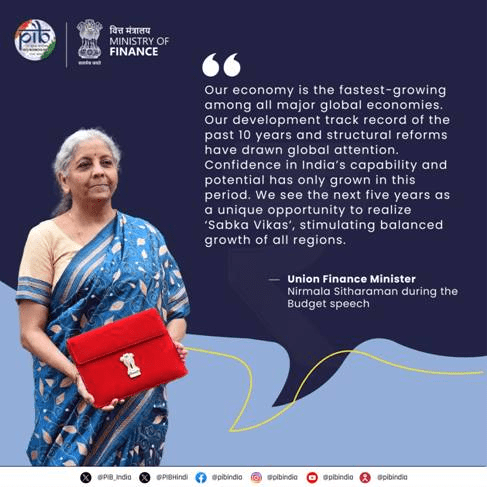
“The new structure will substantially reduce taxes on the middle class and leave more money in their hands, boosting household consumption, savings and investment,” Sitharaman said presenting what was dubbed as ‘reformist’ budget for the next fiscal in Lok Sabha.
The Budget for April 2025 to March 2026 fiscal (FY26) proposed to raise foreign investment limit in insurance sector to 100 per cent from current 74 per cent and continued spending spree on infrastructure while raising allocations for social sectors as well as providing for measures for poor, youth, farmers and women.
All this she did while managing to stick to the fiscal consolidation roadmap, projecting a fiscal deficit of 4.4 percent of the GDP in FY26 as against an estimated 4.8 percent in the current year ending March 31.
Commenting on the announcements, Prime Minister Narendra Modi said it is a “people’s budget” that fulfils the dreams of every Indian and said that it is a “force-multiplier” that will boost consumption, investment and growth.
“The Budget lays a strong foundation to increase savings and make citizens partners in development,” he said.
Sitharaman’s budget has proposals aimed at boosting both consumption and investment, which in turn are expected to give a flip to domestic economic activity, protecting the growth outlook amidst global uncertainties. While maintaining the thrust on infrastructure development, it also continued to provide increasing support to the MSME and the agricultural sector.
Also announced were duty cuts on intermediaries and certain life saving drugs.
To balance the revenue lost, she budgeted a modest increase in capital spending at Rs 11.21 lakh crore in the next financial year compared to a lowered Rs 10.18 lakh crore in current fiscal. Besides, an increase in dividend expected from the Reserve Bank and other government-owned financial institutions will also help to contain the losses.
The budget comes against the backdrop of the Indian economy growing at its weakest pace since pandemic and rising geopolitical risks particularly with the new US President Donald Trump threatening to impose widespread tariffs including on India.
The 6.4 percent GDP growth estimated for the current fiscal and 6.3 to 6.8 percent in the next are well below the 8 percent growth needed to meet the ambitious goal of making India a developed nation by 2047.
“Our endeavour will be to keep the fiscal deficit each year such that the central government debt remains on a declining path as a percentage of the GDP,” she said, projecting debt at 50 percent of GDP by March 2031.
Other measures include a national mission to push high-yielding crops with a special focus on pulses and cotton production, hike in the limit of subsidised credit to farmers to Rs 5 lakh from Rs 3 lakh, missions to push manufacturing and exports, a new policy for labour intensive sectors like leather and footwear and a scheme to make India a global hub for toy manufacturing.
The finance minister also announced a social security cover for nearly 1 crore gig workers and a Rs 10,000 crore fund of funds for startups.
Another major announcement was setting a target of at least 100 gigawatt of electricity from nuclear energy by 2047 and amendment to nuclear liability regulations to allow private sector investment.
Sitharaman also announced reduction in duties on a raft of goods including open cells, while fully exempting critical minerals such as cobalt, scraps of lithium-ion battery, lead, zinc and a few others from import duty.
She proposed a hike in the threshold of tax collected at source on remittances under the RBI’s Liberalised Remittance Scheme from Rs 7 lakh to Rs 10 lakh, benefiting the travel and foreign exchange sectors. Students and individuals seeking medical treatment will also benefit from this.
Rationalising TDS provisions, the finance minister increased the thresholds for non deduction across various TDS provisions broadly ranging from Rs 5,000 to Rs 50,000. The threshold for TDS on rent has been increased from Rs 2.40 lakh to Rs 6 lakh.
That apart, omissions of higher TDS/TCS rates are now applicable for non-filers.
Commenting on the Budget, Christian de Guzman, Senior Vice President, Moody’s Ratings, said: “As the government unveiled its budget for 2025-26 amid a somewhat dampened macroeconomic backdrop as compared to recent years, it has had to slow the pace of fiscal consolidation to provide firmer support to growth.”
“In particular, announced tax relief measures have constrained the growth of revenue receipts, which will rise at its slowest pace since 2022-23; as such, falling expenditure as a share of GDP has borne the brunt of the projected narrowing of the fiscal deficit even as the emphasis on capital expenditure has been sustained,” he said.
“Although the Union government remains on track to meet its near-term policy goals, we do not expect a sufficient improvement in the debt burden, or the proportion of the budget earmarked for debt servicing to change our broader assessment that India’s fiscal strength will remain weaker than most of its investment-grade peers,” he added.
Direct, indirect taxes comprise 66 paise of every rupee in govt coffer: Budget documents
For every rupee in the government coffer, the biggest pie of 66 paise will come from direct and indirect taxes, according to the Union Budget 2025-26 documents.
Around 24 paise will come from borrowings and other liabilities, 9 paise from non-tax revenue like disinvestment, and 1 paise from non-debt capital receipts, the Budget documents said.
Direct taxes, including corporate and individual income tax will contribute around 39 paise, while income tax will yield 22 paise, while corporate tax will account for 17 paise, it said.
Among indirect taxes, goods and services tax (GST) will contribute the maximum 18 paise in every rupee of revenue.
Besides, the government is looking to earn 5 paise out of every rupee from excise duty and 4 paise from customs levy.
The collection from “borrowings and other liabilities” will be 24 paise per rupee, as per the Union Budget 2025-26 presented in Parliament by Finance Minister Nirmala Sitharaman on Saturday.
The Budget documents provide a fractional break-up for Re 1 that comes in and gets spent.
On the expenditure side, the outlay for interest payments and states’ share of taxes and duties, respectively, stood at 20 paise and 22 paise for every rupee.
Allocation for defence stands at 8 paise per rupee.
Expenditure on central sector schemes will be 16 paise out of every rupee, while the allocation for centrally-sponsored schemes is 8 paise.
The expenditure on ‘Finance Commission and other transfers’ is pegged at 8 paise. Subsidies and pension will account for 6 paise and 4 paise, respectively.
The government will spend 8 paise out of every rupee on ‘other expenditures’.
What will become cheaper; what costlier now…
Imported life saving drugs and medicines used in the treatment of cancer, rare and other severe chronic diseases, along with imported premium cars and motorcycles, are set to become cheaper with Finance Minister Nirmala Sitharaman announcing cuts in customs duty in the Union Budget 2025-26.
However, certain items like interactive flat panel (touch screen) displays imported as fully built units and certain knitted fabrics will become costlier due to increase in basic customs duties.
In her speech, Sitharaman said, “To provide relief to patients, particularly those suffering from cancer, rare diseases and other severe chronic diseases, I propose to add 36 lifesaving drugs and medicines to the list of medicines fully exempted from basic customs duty (BCD).”
She further said, “I also propose to add six lifesaving medicines to the list attracting concessional customs duty of 5 per cent. Full exemption and concessional duty will also respectively apply on the bulk drugs for manufacture of the above.”
The finance minister also announced that “specified drugs and medicines under Patient Assistance Programmes run by pharmaceutical companies are fully exempt from BCD, provided the medicines are supplied free of cost to patients.”
“I propose to add 37 more medicines along with 13 new patient assistance programmes,” Sitharaman said.
Although the government has cut duties on several imported items, including marbles, granite and footwear, the impact was neutralised by a hike in Agriculture Infrastructure and Development Cess (AIDC).
Significantly, as per the budget announcement imported premium cars and other motor vehicles with CIF (cost, insurance, and freight) value more than USD 40,000 (about Rs 35 lakh) or with engine capacity more than 3,000 cc for petrol-run vehicles and more than 2,500 cc for diesel-run vehicles or with both will become cheaper as the customs duty has been reduced to 70 percent from 100 percent earlier.
Similarly, motorcycles with engine capacity of 1,600 cc and above imported in completely built unit (CBU) form will also be cheaper as tariff has been slashed to 30 percent from 50 percent.
Likewise, bikes with engine capacity not exceeding 1,600 cc imported as CBU will also become cheaper as tariff has been cut to 40 per cent from 50 per cent.
Motorcycles with engine capacity not exceeding 1,600 cc in imported semi knocked down (SKD) form and completely knocked down (CKD) form will also become cheaper as customs duties have been cut on these items too.
There will also be reduction in prices of imported motorcycles with engine capacity of 1,600cc and above in SKD form following a cut in custom duty to 20 percent from 25 percent and the same imported in CKD form will now attract 10 percent duty, down from 15 percent.
The budget also announced reduction in customs duty on imported parts of electronic toys to 20 percent from 25 percent and that of synthetic flavouring essences and mixtures, used in food and drink industries to 20 percent from 100 percent.
Similarly, articles of Jewellery, goldsmiths’ and silversmiths’ ware and ethernet switches of carrier grade will also become cheaper.
On the other hand, smart meters, solar cells, imported footwear, imported candles and tapers; imported yachts and other vessels will become costlier as cut in import duties on these items have been offset by an increase in AIDC.
PVC Flex Films, PVC Flex Sheets, PVC Flex Banner will also become costlier due to imposition of 7.5 percent AIDC.
Certain imported knitted fabrics are also likely to be costiler as the custom duty structure on it has been changed to 20 percent or Rs115/kg, whichever is higher.
Interactive Flat Panel Displays which are imported as completely built units will also become costlier as the duty has been hiked to 20 percent from 10 percent earlier.