By: Kashmir Images Desk
Deobandi thought in India has been influenced by the Indian ethos and culture, imbibing it with accepting diversity in plurality, and yet maintaining the pristine form of Islam. Thus, due to its Indian ethos, it has gone not in favour of extreme ideologies and syncretism. And the manner in which it has grown over the years and affected and guided millions of Muslims in India and across the world is an acknowledgement of its uniqueness and universality.
The same reasoning could be attributed to the fact that in recent years, in spite of extremist Islamic ideologies being espoused by various scholars and organisations, the ordinary Indian Muslim has not fallen prey to their negative influences.
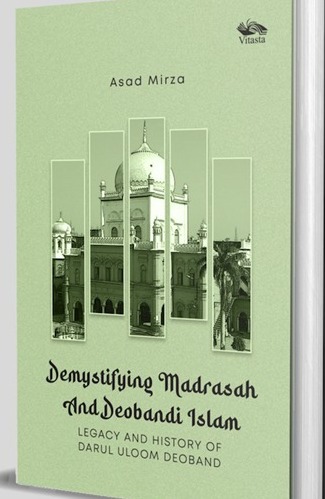
The book under review besides tracking the evolution of madrasahs in India, also traces the origin, evolution and growth of DarulUloom and contribution of its leaders to the Indian polity. Various unknown aspects related to this august institution have been dealt with in depth by the author. Further, he has treated and covered these ideals or thoughts by conducting in-depth interviews with prominent Muslim scholars, academics and religious leaders, like: MaulanaWahiduddin Khan (Late), Maulana Abu QasimNomani, MaulanaArshadMadani, MaulanaAsrar-ulHaqQasmi (Late), MaulanaMahmoodMadani, Maulana Syed RabeyHasaniNadwi, MaulanaSaeed-urRehmanAzmi, Prof Akhtar-ulWasey, Maulana Rashid Kandhalwi, MaulanaKahlidSaifullahRahmani, Ajay Upadhyay, John Butt, Prof EbrahimMoosa, MaulanaSufiyanQasmi, Prof AzamQasmi, MaulanaNadeem-ulWajedi, Dr WarisMazhari and Dr FaheemAkhtarNadvi, over the years.
Through these interviews the author has successfully brought out those aspects of DarulUloom and its Ulema, which to a certain extent remain hidden from a common man. These interviews have been instrumental in delving deep into the Ulema’s psyche on how it shaped and built the DarulUloom, as a centre of anti-colonial forces and how it worked shoulder to shoulder with political organisations like the Indian National Congress.
Further, in a succinct manner the author has also brought to fore the role of DeobandiUlema in movements or campaigns like The Silk Letter Movement (Tehreek-e ReshmiRumal) or their constructive role in establishing the first Indian Government-in-Exile in 1915 in Afghanistan.
In a lucid and nuanced manner the author has also delved into the evolution of Indian madrasahs since the beginning and the role played by them, in contributing to the spread of education not just amongst Muslims but also amongst non-Muslims.
It is an irony that Muslim institutions like DarulUloom, Deoband often resist efforts to highlight their contribution to the Indian polity. The last authoritative book on the topic was written in 1962 and much water has flown under the bridge, and in between a false narrative and idea of DarulUloom has been formed in the public’s mind about this august institution. The author has painstakingly given a completely fresh perspective about the institution, through the insightful interviews with leading authorities on the subject.
Moreover, DarulUloom has not remained unmarred by controversies, the most important of which the division of the DarulUloom into two separate institutions led by two different families of the founders of the DarulUloom. Much less has been reported about this in the Urdu press what to say about the English press. But the author has candidly covered this controversy also, an issue on which most Muslim Ulema adopt an ambiguous stand or keep mum.
All in all, the book provides a completely unknown or lesser-known picture of the Indian madrasahs, DarulUloom and Deobandi Islam. It also does not shy away from discussing the contentious issues like Madrasah reform and curriculum.
AsadMirza is a senior journalist based in Delhi. His interests range from international and strategic affairs to interfaith issues, besides Indian Muslims and Indian polity. Previously he has been associated with KhaleejTimes-Dubai, and BBC World Service in India and currently he works as an independent columnist and Consulting Editor of a leading defence magazine. His earlier books: Abrahamic Faiths and Interfaith Dialogue: An Indian Perspective focussed on interfaith issues. Currently he is working on recreating the live history of Old Delhi of yesteryears.
Book: Demystifying Indian Madrasah and Deobandi Islam
Author: Asad Mirza
Publisher: Vitasta Publications, N Delhi
Pages: 280
ISBN: 978-81-19670-76-5
Price: INR 595