

Sufism (Tasawwuf) is a well-established subject read and researched globally. In Islam, it is the name given to mysticism. Sufism embraces the philosophy and practices aiming at unswerving communion between God and man. Sufism can also be explained from the perspective of the three basic religious attitudes mentioned in the Qur’an. These are the attitudes of Islam, Iman, and Ihsan.
There is a Hadith of the Prophet (saw) which describes the three attitudes separately as components of Din (religion), while several other traditions in the Kitab-ul-Iman of Sahih Bukhari discuss Islam and Iman as distinct attitudes varying in religious significance. These are also mentioned as having various degrees of intensity and variety in themselves.
The attitude of Islam, which has given its name to the Islamic religion, means Submission to the Will of Allah. This is the minimum qualification for being a Muslim. Technically, it implies an acceptance, even if only formal, of the teachings contained in the Qur’an and the Traditions of the Prophet (saw).
Iman is a more advanced stage in the field of religion than Islam. It designates a further penetration into the heart of religion and firm faith in its teachings. Ihsan, the third quality, is the highest stage of spiritual advancement. At this stage, the devotee has such a realization of the religious truths which amounts almost to their direct vision. This quality of Ihsan, which was later termed as Mushahidah (Direct seeing) by the Sufis, is described in the Tradition by the Prophet (saw) as “Ihsan is to adore Allah as though thou do see Him for even if thou do not see Him, He nonetheless sees thee.” According to these three stages of religiosity, Sufism may be defined as the Spiritual Progress of a devotee from the initial stage of Islam to the final stage of Ihsan.
Though a section of scholars repudiates it, there is no denying that a gigantic chunk acknowledges it as an inseparable part of Islam related to the believer’s spiritual facet. It is said ‘Allah’s proximity is to the soul what food is to the body’ and Sufism is the way to attain that.
Originally, Sufism has its roots in the era and lifestyle of Prophet Muhammad (saw) and his companions. With time, the need was felt for its preaching. Sufis not only vocalized their messages but also recorded them on paper. This way series of books that became essential guides to Saliks (Travellers of the Sufi path) sprung out. The first of these books was “Al-Risala al Qushayri” by Imam Qushayri, followed by significant works such as “Kashf-ul-Mahjub” by Syed Ali Hujwiri, “Kitab-ul-Luma’” by Abu Nasr Sarraj, “Awarif-ul-Maarif” by Shahab-u-din Suharwadi, “Futuh-ul-Ghaib” by Syed Abdul Qadir Gilani, “Al-Arba’in” by Al-Ghazali, and “Maktubat” by Mujaddid Alf Thani.
This tradition of writing on Sufism has continued and remains vibrant today. Contemporary philosophers like Dr. Tahir-ul Qadri, Farida Khanum, Dr. Hussain Mohi-u-din Qadri, and Shaykh Fadhlalla Haeri are instrumental in perpetuating and clarifying the concept.
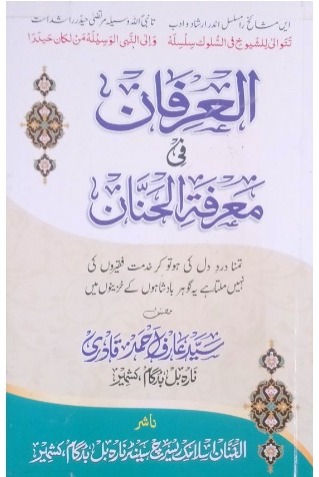
In Kashmir, Sufism is deeply cherished, evident from the large pilgrimages to shrines, the convening of congregations, symposiums, debates, and extensive scholarly writing. A young researcher, Syed Arif Ahmad Qadri, has emerged as a prominent figure in promoting Sufism among the youth. His new book, “Al-Irfan fi Muarifat-il-Hanan,” is a commendable effort to unravel the mysteries of Sufism clearly and systematically. The 224-page book explores barely 32 topics quintessential to comprehending Sufism and the Sufi way of life. Forewords by Syed Saad-ud-din Qadri, Dr. Sameer Shafi Siddiqui, and Mufti Asadullah Misbahi denote the significance of a book.
In prolusion, Syed Asif Raza provides a window to understand narratives and counter-narratives about Sufism. His mordant analysis busts the myths as if Sufism is a parallel religion or has nothing to do with Islam.
The author starts with an introduction to Sufism. He rests his argument on the Quran, Hadith, and statements of classical scholars like Imam Ghazali. The original term Ihsaan –has been discussed at length and this is followed by topics like ‘stations and stages in Sufism — Shariat (exoteric path, Tariqat (esoteric path) aur Muarifat (final mystical knowledge),Nafs (the soul,ego, responsible for one’s good and evil), Maqamaat-e-Nafs (stations of nafs), Qalb(concept of heart ),Tasawuf mein Qalb ki Ahmiyat (salience of heart in Sufism), Aqsaam’e qalb (types of heart), Bayah (an oath of allegiance to spiritual guide), Aqsaam’I byah (kinds of an oath), Murshid kis say kehtey hain (Who is Murshid — A spiritual guide/mentor), Murshid kay awsaaf (etiquette of mentor), Quran o hadith mein Murshid ki ahmiyat (Importance of mentor in accordance with Quran and hadith), Mureed aur Mureed kay awsaaf ( A sufi disciple and his compulsory qualities) , Wilayat aur Martaba Wilayat (Sainthood and its status) Wali Kis say kehtey hain (Who’s saint), Awliya kay Aqsaam (Kinds of Saints), Fana-fi-Allah (meaning to die to the world and to subsist in God alone), Fana aur baqa (extinction : subsisting in God), Arif kaun hai (Who is Arif — a person who knows God through personal spiritual experiences and vision) , Awliya aur tark-e-lazaat (Saints and their abstinence ), Maqaam’e Fuqraa-e-kamileen (status of sufi mendicant), Darwish kiesa hona Chahiye (how a Darwish (what a religious mendicant should look like) etc.
Each topic holds treasures of knowledge and the corroborations the author has put to confirm his point are exemplary. The trenchant comments of Imam e Ghazali, Mujaddid Alf-Thani, Maulana Rumi, Baba Dawud Khaki, and Sayyid Muhammad Qasim Shah Bukhari not only maintain the veracity of the book but also help a reader to get to the heart of the matter. Syed Arif Qadri has dedicated this book to his lost teen son — Hanan, so the name “Al-Irfan fi Muarifat-il-Hanan”. Written in a legible format the book is easily graspable to comprehend cryptic concepts candidly. Moreover, for any student of Sufism, it can be the best choice.
Writer is a student, educator, and columnist. He tweets @Zeeshan_rk and can be mailed at mohdzeeshan605@gmail.com


