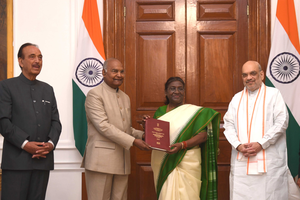
New Delhi: A high-level panel on Thursday recommended simultaneous elections for Lok Sabha and state assemblies as the first step followed by synchronised local body polls within 100 days in its report on ‘one nation, one election’ submitted to President Droupadi Murmu.
Simultaneous polls will help save resources, spur development and social cohesion, deepen “foundations of democratic rubric” and help realise the aspirations of “India, that is Bharat”, the panel headed by former president Ram Nath Kovind said in its report that runs into more than 18,000 pages.
However, the panel has made 321 pages public.
The committee noted that B R Ambedkar had envisioned the necessity of uniformity in the electoral process and further advocated for the Union to be responsible for conducting elections in India.
Separately, the Law Commission is also likely to come up with its own report on simultaneous polls, of which Prime Minister Narendra Modi has been a strong votary.
Sources said that the Law Commission is likely to recommend holding simultaneous polls for all three tiers of government — Lok Sabha, state assemblies and local bodies like municipalities and panchayats — starting with 2029 and a provision for unity government in cases like hung house or no-confidence motion.
The 2024 general elections for Lok Sabha, along with four state assemblies, are expected in April-May amid indications that the Election Commission may announce these polls as early as this Friday.
The Kovind panel, which has not specified any period for rolling out simultaneous polls, said that in the first stage, elections for the Lok Sabha and all state legislative assemblies can be held together.
In the second step, the elections to municipalities and panchayats will be synchronised with the Lok Sabha and state assemblies in such a way that elections to municipalities and panchayats are held within 100 days of the holding of parliamentary and assembly polls.
For the purpose of synchronising Lok Sabha and assembly elections, the committee recommended that the President notifies the date of the first sitting of the Lok Sabha after a general election as the “appointed date”.
The tenure of all state assemblies formed after polls after the “appointed date” and before the expiry of the full term of the Lok Sabha, will be only for the period ending up to the subsequent parliamentary polls.
After this one-time transitory measure, all Lok Sabha and assembly polls will be held simultaneously.
The committee recommended that fresh elections could be held to constitute a new Lok Sabha in the event of a hung House or a no-confidence motion, or any such event.
Where fresh elections are held for the House of the People (Lok Sabha), the tenure of the House will be “only for the unexpired (remaining) term of the immediately preceding full term of the House”, it said.
When fresh elections are held for state legislative assemblies, then such new assemblies — unless sooner dissolved — shall continue up to the end of the full term of the Lok Sabha.
To bring into force such a mechanism, Article 83 (duration of Houses of Parliament) and Article 172 (duration of state legislatures) need to be amended, the committee said.
It has also proposed creation of an “Implementation Group” to look into the execution of the panel’s recommendations.
The panel also recommended preparation of a common electoral roll and voter ID cards by the Election Commission of India in consultation with state election authorities.
At present, the ECI is responsible for Lok Sabha and assembly polls, while local body polls for municipalities and panchayats are managed by state election commissions.
The panel recommended as many as 18 constitutional amendments, most of which will not need ratification by state assemblies. However, these would require certain Constitution amendment bills that would need to be passed by Parliament.
Some proposed changes regarding the single electoral roll and single voter ID card would need ratification by at least half of the states.
At present, ECI prepares electoral roll and voter ID cards for Lok Sabha and assembly polls, while the same for local body elections are managed by state election commissions which come under the domain of respective state governments.
“Now, several elections are being held every year. This casts a huge burden on the government, businesses, workers, courts, political parties, candidates contesting elections, and civil society at large,” the panel said.
It said the government must develop a “legally tenable mechanism” to restore the cycle of simultaneous elections.
An official statement said the committee crafted its recommendations in such a way that they are in accordance with the spirit of the Constitution and would require bare minimum amendments to the Constitution.
Kovind was accompanied by other panel members, including Home Minister Amit Shah, former Finance Commission chairman N K Singh, former Lok Sabha secretary general Subhash Kashyap, former leader of opposition in Rajya Sabha Ghulam Nabi Azad and Law Minister Arjun Ram Meghwal, when he went to submit the report to the president at Rashtrapati Bhavan.
The committee said for making logistical arrangements for simultaneous elections to Lok Sabha and state assemblies, ECI could draw a plan and estimate in advance for the procurement of EVMs and VVPATs, deployment of polling personnel and security forces.
Similarly, for local body polls, state election commissions, in consultation with ECI, could draw a plan for themselves.
Six states are due to have elections this year. Arunachal Pradesh, Sikkim, Andhra Pradesh and Odisha are likely to go to polls in June, followed by Haryana and Maharashtra in November.
In 2025, Jharkhand, Bihar and Delhi will go to polls.
In 2026, West Bengal, Tamil Nadu, Assam, Kerala and Puducherry will have elections, followed by Manipur, Goa, Punjab, Uttarakhand, Uttar Pradesh and Gujarat in 2027.
Finally, in 2028, the remaining 10 states will undergo assembly elections. These are Himachal Pradesh, Meghalaya, Nagaland, Tripura, Karnataka, Telangana, Mizoram, Madhya Pradesh, Chhattisgarh and Rajasthan.
Top 10 recommendations of Kovind panel’s report
The top ten recommendations on simultaneous polls made by the high-level panel on ‘one nation, one election’ are:
* Government must develop a legally tenable mechanism in order to restore the cycle of simultaneous elections
* In the first stage, elections for the Lok Sabha and all state legislative assemblies can be held together.
* In the second step, the elections to municipalities and panchayats will be synchronised with the Lok Sabha and state assemblies in such a way that elections to municipalities and panchayats are held within 100 days of the holding of parliamentary and assembly polls.
* For the purpose of synchronising Lok Sabha and assembly elections, the president shall notify the date of the first sitting of the Lok Sabha after a general election as the “appointed date”.
* The tenure of all state assemblies formed via polls after the “appointed date” and before the expiry of the full term of the Lok Sabha, will be only for the period ending up to the subsequent parliamentary polls. After this one-time transitory measure, all Lok Sabha and assembly polls will be held simultaneously.
* Fresh elections could be held to constitute a new Lok Sabha in the event of a hung House or a no-confidence motion, or any such event.
* Where fresh elections are held for the House of the People (Lok Sabha), the tenure of the House will be “only for the unexpired (remaining) term of the immediately preceding full term of the House.
* When fresh elections are held for state legislative assemblies, then such new assemblies — unless sooner dissolved — shall continue up to the end of the full term of the Lok Sabha.
* A single electoral roll and Elector’s Photo Identity Card (EPIC) shall be prepared by the Election Commission of India in consultation with the State Election Commission and the same will substitute any other electoral roll prepared by ECI.
* For making logistical arrangements for the conduct of simultaneous elections, the ECI may draw up a plan and estimate in advance for the procurement of equipment, such as EVMs and VVPATs, deployment of polling personnel and security forces and make other necessary arrangements.