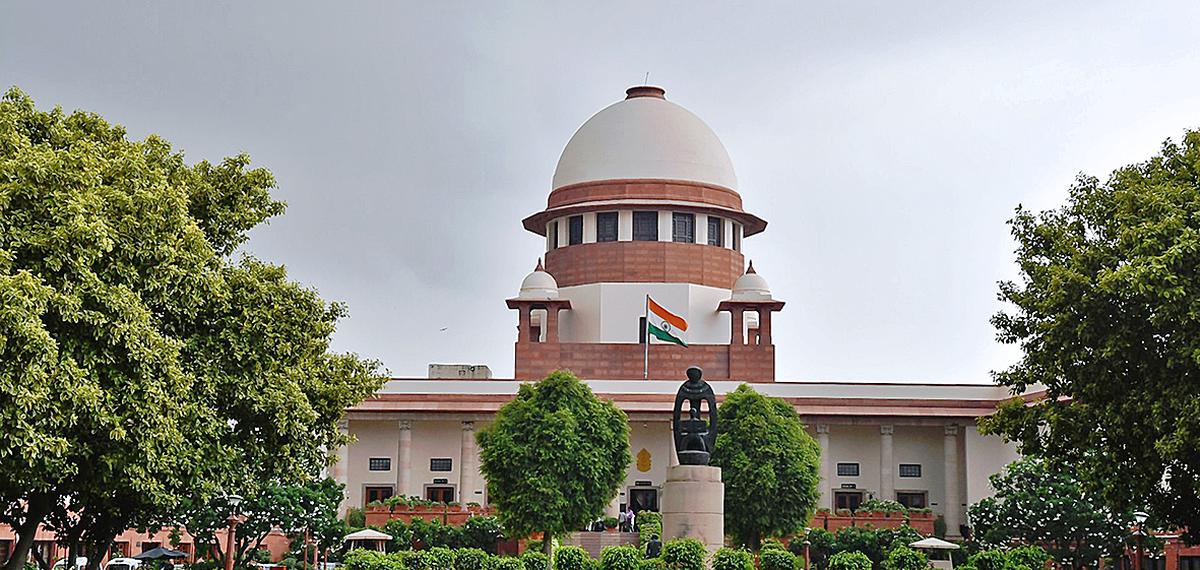
New Delhi: Commencing their arguments in support of abrogation of Article 370 in the Supreme Court, the Centre’s top law officers Thursday asserted there was no “constitutional fraud” in annulling the provision that accorded special status to the erstwhile state of Jammu and Kashmir.
The five-judge constitution bench headed by Chief Justice D Y Chandrachud, which heard their contentions at length, told them they will have to justify the procedure adopted for abrogation as the court cannot postulate a situation “where the ends justify the means”.
The petitioners opposing the repeal of Article 370 have been insisting that the provision could not have been abrogated, as the term of the Jammu and Kashmir Constituent Assembly, whose concurrence was required before taking such a step, ended in 1957, after it had drafted the erstwhile state’s Constitution. With the constituent assembly having become extinct, Article 370 acquired a permanent status, they have said.
“We cannot postulate a situation where ends justify the means. The means have to be consistent with the ends,” the CJI observed when Attorney General R Venkataramani said it was necessary to abrogate Article 370 and there were no infirmities in the process adopted.
There was no constitutional fraud, as alleged, in abrogation of the provision, said Venkataramani, who opened arguments on behalf of Centre.
“Due process was followed. There was no wrong-doing and there was no constitutional fraud as alleged by the other side. The step was necessary to be taken. Their argument is flawed and inconceivable,” Venkataramani told the bench, also comprising Justices Sanjay Kishan Kaul, Sanjiv Khanna, BR Gavai and Surya Kant.
CJI Chandrachud told Solicitor General Tushar Mehta, also appearing for the Centre, that eventually he will have to explain as to how the word “constituent assembly” which existed in clause 2 of Article 370 was replaced with the word “legislative assembly” on August 5, 2019, the day the provisions of Article 370 were done away with.
“You will have to argue how it was not a constituent assembly but a legislative assembly in its original form. You will have to answer how it will square up with clause 2 of Article 370 which specifically says the constituent assembly formed for the purpose of framing the constitution of that state….because, there is a textual answer which may militate against your line of approach,” CJI Chandrachud told Mehta.
The solicitor general said he will try to satisfy the conscience of the court and explain the procedure adopted and how it was constitutionally permissible.
The relevant provision of Article 370, before its reading down in 2019, said: “Notwithstanding anything in the foregoing provisions of this article, the President may, by public notification, declare that this article shall cease to be operative or shall be operative only with such exceptions and modifications and from such date as he may specify: Provided that the recommendation of the Constituent Assembly of the State referred to in clause (2) shall be necessary before the President issues such a notification.”
On August 5, 2019, the newly inserted Article 367(4)(d) amended Article 370(3) by replacing the expression “Constituent Assembly of the State” with the “Legislative Assembly of the State”.
“I will show how Article 370 worked till 2019. Some of the things are really shocking and I want the court to know about it. Because, practically two constitutional organs-state government and the President — in consultation with each other, can amend any part of the Constitution, whichever way they want and apply it to Jammu and Kashmir,” Mehta said.
As an example, Mehta said the preamble of the Indian Constitution was made applicable to Jammu and Kashmir by way of Constitution Order under Article 370(1)(b) in 1954.
“Thereafter the 42nd amendment took place in 1976 and the words ‘socialist’ and ‘secular’ came to be added in the Indian Constitution but that was not made applicable (to J&K) till August 5, 2019. The Constitution of Jammu and Kashmir was not having either the term ‘socialist’ or ‘secular’,” Mehta said, adding he will show the “devastating effect” Article 370 could have had if it were not repealed.
“This court has rightly flagged that the end may not justify the means but I will justify the means also. They are constitutionally permissible,” Mehta said.
The CJI asked the Centre to furnish a list of states out of the 562 princely states which merged with India without signing any merger agreement besides original papers existing with the Department of State under the Ministry of Home Affairs.
The solicitor general countered the argument of the petitioners that Article 370 was a special feature and it was a privilege given to the people of Jammu and Kashmir which could never be taken away, and said there were several similarly situated princely states, which put certain conditions for integration but eventually subsumed themselves with the Union because of Article 1 of the Constitution.
The bench prima facie agreed with the submissions of Mehta and said the only difference was that princely states like Kathiawar, Saurashtra and Baroda did not follow the Article 370 route but still were integrated with India.
“For J&K the Constitution decided to go to Article 370 and for other states there was no provision like Article 370. They merged and they were integrated completely. They accepted List 1, they accepted List 3 and they accepted the ultimate powers of the legislature of dominion of India,” the bench said.
The CJI said many of these states came into the Union of their own volition.
“We take it as voluntary but there may have been little bit of persuasion, there may have been politics involved. This is because of a genius like Sardar Patel and there is no doubt about it. But the fact, however, remains is that in so far as J&K is concerned, it bucked that trend and went through the Article 370 route,” CJI Chandrachud added.
Mehta also countered the argument of petitioners that the instrument of merger was a necessary attribute for complete integration otherwise there existed a kind of internal sovereignty.
“This court may recall that J&K never signed the instrument of merger but then many states did not sign the instrument of merger. But, from the date on which the Constitution of India came into force and Article 1 came into force, they became an integral part of India,” he said.
He also questioned the argument of the petitioners that although J&K gave up its external sovereignty, there existed internal sovereignty with the erstwhile state.
“In my view, the petitioners are confusing internal sovereignty with autonomy. External sovereignty nobody can dispute it is with UOI (Union of India) and internal sovereignty in the facts of our case and the constitutional structure which we have accepted, would mean autonomy of a federating unit. This autonomy exists with every state,” Mehta submitted.
The CJI agreed with the submission and said, “Yes, this is there with every institution. This exists with every autonomous institution. Like we have autonomous authority to decide the constitutional issue, so we can’t say that internal sovereignty vests with us. We are an independent autonomous institution under the Constitution.”
The hearing remained inconclusive and will resume on August 28.
Several petitions challenging abrogation of the provisions of Article 370 and the Jammu and Kashmir Reorganisation Act, 2019, which split the erstwhile state into two union territories – Jammu and Kashmir, and Ladakh – were referred to a Constitution bench in 2019.