By: Dr.Satyawan Saurabh
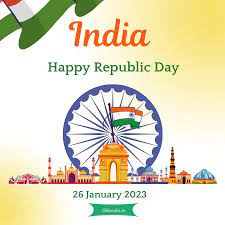
Every year, Republic Day in India is celebrated on 26 January to commemorate the date on which the Constitution of India came into force and the country became a republic. Every year, 26 January is celebrated with festivity and patriotic fervor across the country. This year India is celebrating its 73rd Republic Day. To celebrate the Amrit Mahotsav of Independence, several activities were launched to mark the Republic Day Celebrations 2023. The main component of Azadi Ka Amrit Mahotsav is to connect the youth with our rich cultural heritage. The activities aim to unearth the best talent across the country and at the same time, provide an opportunity to be a part of the Republic Day celebrations of 2023.
India has indeed made great democratic achievements, but after independence the high ideals we should have set in this country and society, we are today going in exactly the opposite direction and are rampant in corruption, dowry, human hatred, Problems like violence, obscenity, and rape are now becoming a part of life. But our country has been facing many problems since ancient times, at present India is the most populous country, and in such a situation youth will have to democratize the country, society, and family by increasing their participation.
Though India has carved its niche as one of the fastest-growing economies in the world, it is also losing a lot in the name of development. Poverty remains the biggest challenge of today’s India, with the majority of people living below the poverty line and a huge divide between the rich and the poor. Gender discrimination persists at all levels, with disproportionate female ratios, few economic opportunities, inequality in wages, violence, malnutrition, etc.
Corruption in public life has been a major concern in India. India ranks 78 out of 180 countries in the Corruption Perceptions Index released by Transparency International. It is present in both covert and overt forms at all three levels – politics, bureaucracy, and the corporate sector. Communalism and religious fundamentalism have assumed very dangerous forms and dangerous forms in India. It is an affront to India’s nationalist identity and a sad blow to its developed secular culture.
For the success of political democracy, its alliance with economic democracy and social democracy is necessary. Economic democracy means that every member of society should get equal material facilities for his development. There should not be much economic disparity between people and one person cannot exploit another person. On the one hand, it is not possible to build a democratic nation in an environment of extreme poverty, and on the other hand, social democracy means that there is a lack of privileges at the social level. But these two are still not established in India. 1% of our country’s rich have more than 85% of the country’s wealth, the total wealth of 63 billionaires in the country is equal to the national budget.
Along with this, inequality, gender, caste, and religious discrimination prevent the country from establishing a real democracy. The criminalization of politics and the use of money power in elections has been major problem in Indian elections. In the present Lok Sabha, there are more than 200 MPs against whom criminal cases are registered. Along with this, poverty, and corruption in the country have affected the election system by spreading despair in the daily life of the people. The increasing influence of muscle power, money power, casteism, communalism, and corruption in political life has made the political scenario poisonous! India’s arduous, far-reaching and lengthy judicial process has brought about a state of justice in the country.
Many times, due to bad governance, the fairness of justice has come into the dock. Justice delay is often equated with injustice. More than 3 lakh cases are pending in our judiciary. The civil service and the police service from the colonial legacy consider themselves to be masters whereas in a democracy both are considered to be service providers. Along with this, concepts like patriarchy, and khap panchayat have weakened democracy in the country. There is also a concern that both the family and society, the primary unit of grouping in India, are no longer democratic.
Indian democracy also struggles with regionalism which is mainly a result of regional disparities and imbalances in development. A persistent sense of inequality within and between states creates a sense of neglect, deprivation, and discrimination. Elections, which serve as the most visible expression of democracy, are tainted by the misuse of money and muscle power by politicians and political parties. Most of the politicians have pending criminal cases against them; The sources of funding for the elections remain questionable.
Our republic has come a long way and we should appreciate how far successive generations have brought us. Equally, we must appreciate that our journey is not over yet. There is a need to re-examine our criteria of achievement and success – from quantity to quality; In order from a literate society to a knowledgeable society. No concept of India’s development can be complete without saluting our spirit of inclusiveness.
India’s pluralism is its biggest strength and its biggest example for the world. The “Indian model” rests on the tripod of diversity, democracy, and development where we cannot choose one over the other. The nation needs to be inclusive of all classes and all communities so that the nation is transformed into a family that invokes, encourages, and celebrates the uniqueness and potential of every individual.
The writer is a Poet, freelance journalist and columnist, All India Radio and TV panellist.