By: Khurram Husain
THE joint statement released at the end of the visit by Prime Minister Imran Khan to China last week was one of the most detailed and comprehensive such statements that I have seen in this relationship, at least since CPEC got going. This is not necessarily a mark of success for the government, which went more to seek immediate relief so as to avoid an IMF programme, in the words of Imran Khan himself. It is a mark of the massive shift that CPEC, as well as the larger body of Pakistan-China relations, is about to undertake.
Compare this statement with an earlier one, for perspective on how far down the road we have travelled in the evolution of our relationship with our Chinese friends. In 2003, Pervez Musharraf visited China and the two countries issued the Joint Declaration on Directions of Bilateral Cooperation, in which language began to appear pointing towards “mutually beneficial economic and trade cooperation”.
In 2005, Chinese Premier Wen Jiabao visited Pakistan and the two countries signed the Treaty of Friendship, Cooperation and Good Neighbourly Relations, as well as launching the talks on the first Pakistan-China Free Trade Agreement (FTA).
These three treaties and agreements form the core of the relationship around which everything is now developing. It was in the early 2000s that the relationship moved beyond the more narrow strategic concerns within which it had remained since 1951, when the two countries first established diplomatic ties.
The joint statement issued after that meeting spoke of “beneficial cooperation in agriculture, forestry and fishery”, as well as the “rich natural resources”, cooperation between “relevant enterprises and departments in agricultural technology, processing of agricultural and forest products, manufacturing of agricultural machineries, offshore fishing and aquaculture”.
It also spoke of “close cooperation in the industrial sector” to include “development of industrial zones, industrial harbours, export free zones” and encourage “collaboration of the private sectors of the two countries” to establish joint ventures, “particular in the field of textile manufacturing”.
In short, what was being discussed in that meeting back in 2003 sounds very much like a precursor to what eventually became the CPEC long-term plan. The latest joint statement grows out of this beginning, with its emphasis on the establishment of industrial zones, investment in agricultural technology and farming, and the marine economy.
The treaty of friendship signed in 2005 was a standard one that China was signing with all other countries in its region. The first had been with Russia in 2001. It simply outlined that China and its neighbours will respect each other’s sovereignty, refrain from using economic pressure against each other, and will respect and work with each other within the UN Charter, and reaffirmed China’s unification policy with respect to Taiwan. Every joint statement issued by China and Pakistan since then has reiterated these principles.
There is one thing that is new in the latest one. “The two sides agreed that JCPOA is an important outcome of multilateralism and a good model of negotiated settlement of complex issues through dialogue and diplomacy,” says the latest joint statement.
Clearly, China is concerned about the rising belligerence being shown towards Iran by the United States. The language can even be read to suggest that China views with concern the possibility that Pakistan may veer too far into the Saudi Arabian orbit, and become too enmeshed in the diplomatic push by the kingdom to isolate Iran in its own region.
The Pakistan-China FTA was signed in 2006, and the next joint statement came in 2008 after then president Asif Zardari’s visit to China in October of that year, as an economic crisis was engulfing the country. That statement reaffirmed the treaty of friendship of 2005 as the building block of all future relations, “opposed” terrorism, extremism and separatism (as opposed to the current statement which says both countries will “enhance cooperation” to combat these “three evils”) and agreed to pursue a Five-Year Development Programme on Economic Cooperation. Twelve MoUs were also signed during this trip, on areas ranging from agriculture cooperation to cricket.
In 2011, this was followed by the creation of the rupee-yuan swap agreement, through which both countries could move towards paying for bilateral trade in local currency (which was formally launched in 2013, though has not seen much use by traders since then).
This was the background to the beginning of what we now call CPEC that has become the lens through which all Pakistan-China relations are now viewed. CPEC built on this past history, gave detail to what is meant by “agriculture cooperation” and “tourism development”, but it is not where these priorities originated. They were formally incorporated in the long-term plan that was finalised by both parties in November last year.
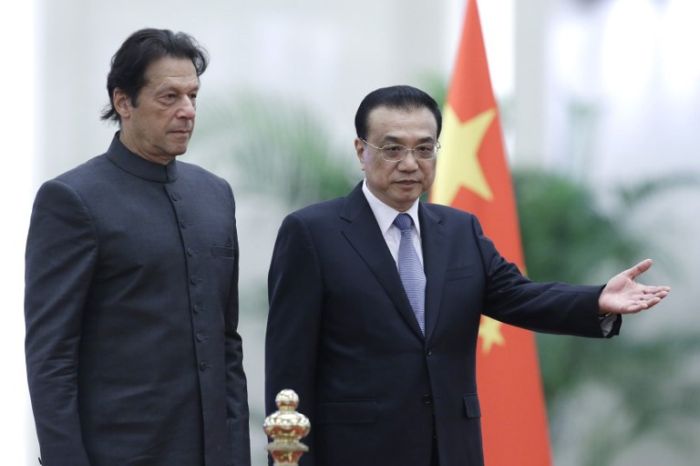
Since then, Pakistan has been in the grip of political uncertainty and held a general election. A new government emerged from this election, and in its early days promised greater transparency, greater disclosure, of all CPEC agreements, as well as a review and possible change of course. None of that happened. The visit to Beijing was a sobering moment for Imran Khan, whose body language appeared diminutive, fidgety and nervous through it all. At the Shanghai Expo, he even read his speech from a piece of paper, something he and his followers had berated Nawaz Sharif for doing as if it were a sign of weakness.
The Chinese stage is too heavily adorned with agreements, treaties and all manner of understandings to be changed significantly now. The momentum behind the relationship is virtually unstoppable now. One feels that inexorable momentum in the pronouncements emerging from the Chinese side, where statements given by Pakistani ministers are denied by the Chinese on some occasions. The latest joint statement does not herald a new era in Sino-Pak relations, but it certainly shows that gears are changing, and many of the terms of the long-term plan are now ready to be activated.
Courtesy Dawn