By: Vrinda Grover
It is a chilling coincidence that on October 31, a date that marks the assassination of Prime Minister Indira Gandhi in 1984 and the unleashing of state-engineered violence against the Sikhs, the Delhi High Court held 16 policemen of the 41st Battalion of UP Provincial Armed Constabulary (PAC) guilty of “the targeted killing by armed forces of the unarmed, innocent and defenceless members of a particular community”.
The HC judgment makes a significant jurisprudential advance by foregrounding this not as a case of indiscriminate firing by a trigger-happy police force, but rather locating the motive for the cold-blooded murders in the Muslim identity of the victims. “A disturbing aspect of the present case is the targeted killings of persons belonging to one minority community… This was a case of targeted killing revealing an institutional bias within the law enforcement agents in this case,” the court said.
Despite mounting evidence and experiences, for too long there has been a silence and denial about the structural and systemic nature of the prejudice within law enforcement agencies against religious minorities. This is most starkly manifest in police (in)action during the 1984 anti-Sikh carnage, Gujarat 2002 attack on Muslims, the 2008 anti-Christian riots in Kandhamal, the malafide investigations of the Malegaon and Mecca Masjid blasts, the tardy probes in the lynching cases, to name a few. There is an urgent need to acknowledge that institutional bias, as identified by Lord MacPherson in 1999, in the context of racism in UK, is embedded in the police force.
In 2013, the report of a committee comprising of DGPs of three states notes: “Minorities view police as being communal and allege that they deal with situations involving two communities in a partisan manner favouring the majority community.” Further that “unfortunately for police, demeanour of some police officers and men in several serious communal riots in recent and not so recent past has served to strengthen such beliefs”. A 2018 report of Centre for Study of Developing Societies and Common Cause — Status of Policing in India Report, 2018: A Study of Performance and Perceptions — based on a survey of 22 states, found that about 64 per cent of Indian Muslims interviewed are either “highly” or “somewhat” fearful of the police as they fear false implication and have a perception that the police discriminates on the basis of religion.
Will this not decisively erode the constitutional rights to life, equality and non-discrimination and abridge the right to justice of minority communities? A communalised police force subject to weak mechanisms of accountability constitutes a grave threat and will reinforce the already etched patterns of impunity for mass crimes. Those championing the cause of police reform and accountability need to take a lead in instituting corrective measures, as the systemic nature of this bias is a grave threat to the life and liberty.
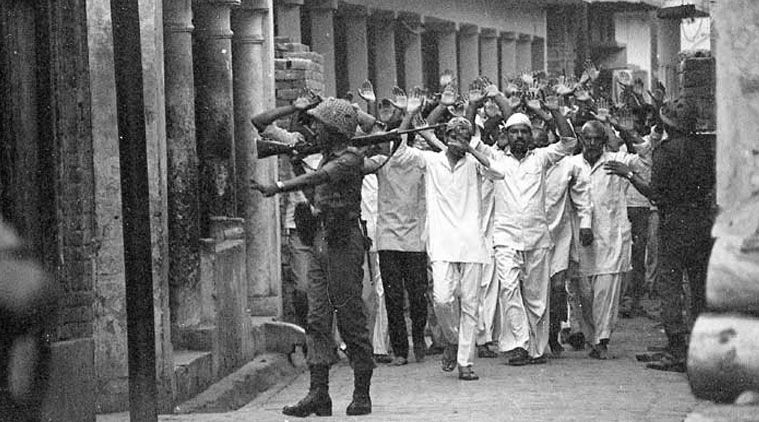
Thirty-one years ago, during the course of communal tension in Meerut district, on May 22, 1987, a search and arrest operation was launched by the police, PAC, and the Army, in Mohalla Hashimpura, ostensibly because a day earlier two PAC rifles were stolen by rioters. This lead to the arrest and detention of 644 Muslim men, some of whom were taken to prisons. Thereafter, 42-45 able-bodied men were abducted by 19 armed PAC men in PAC Truck URU-1493, taken to Gang Nehar and then Hindon canal, shot and the bodies thrown into their watery grave. Five men who dodged death, bearing the scars of the bullets, narrated the macabre details of the killings, before the trial court. In 2006, they testified to being witness to the abduction and cold-blooded murders by PAC men, but could obviously not identify the uniformed men who fired in the dark night.
In 2015, the trial court acquitted the 16 surviving PAC accused (three others, including the commandant, Surendra Pal Singh, had died during the trial), holding that it was “a horrific incident of targeted abduction and killing of around 42 persons by the officers of PAC”, but that there was no clinching evidence on record relating to the identity of the truck and accused persons. Why was it that even after a nine-year long CB-CID investigation the evidence to determine the identity of the perpetrators was not placed before the court? After all, the names and identity of the accused and the truck are scribed in the official records, the duty and attendance registers, general diary register relating to daily movement of personnel, log-book of the truck etc. All these documents are with the PAC.
But the one piece of evidence that contained the identities of the perpetrators was not produced before the Delhi trial court, where the trial was transferred in 2002. During the appeal before the HC the National Human Rights Commission (NHRC) filed an intervention seeking specific documents which were suppressed by the state. After multiple attempts at obfuscation, denial and admissions of weeding out documents while the trial was pending, the original general diary register of the “C” Company of 41st Battalion PAC was produced by the state of UP. This records that on May 22, 1987, at 7.50 am, Commandant S P Singh along with his platoon of 19 men, all named, armed with 17 rifles, one revolver and ammunition, left the headquarters in truck number URU-1493. For 31 years, this original document had been suppressed to shield the accused and impunity assured.
We continue to witness investigations designed to shield perpetrators as a theme in cases of mob-lynchings or extra-judicial killings, further cementing impunity. Fact-finding reports by PUDR and others document that Muslims were killed in the two neighbouring areas, Hashimpura and Maliana, in May 1987. Maliana, where over 70 were killed, has been erased from our public records and discourse. The Hashimpura judgment has invoked the “right to know the truth”, originally conceptualised in international law in the context of enforced disappearances, which provides that “a people’s knowledge of the history of its oppression is part of its heritage… aimed at preserving the collective memory from extinction and, in particular, at guarding against the development of revisionist and negationist arguments”.
Courtesy Indian Express