By: Brinda Karat
While heated debates and discussions were expected after the Supreme Court’s Sabarimala judgment, what is unusual is the kind of public intervention made by Union Minister Smriti Irani in her widely reported speech in Mumbai. Quite apart from the crudity of the statement, which is objectionable enough, Ms. Irani advised women to accept that menstrual blood is impure and that a menstruating woman desecrates a place of worship. When she was criticised for her statement, she put out a defence which made this even more clear: “Since many people are talking about my comments — let me comment on my comment. As a practising Hindu married to a practising Zoroastrian I am not allowed to enter a fire temple to pray. I respect that stand by the Zoroastrian community / priests and do not approach any court for a right to pray as a mother of 2 Zoroastrian children. Similarly Parsi or non Parsi menstruating women irrespective of age DO NOT go to a Fire Temple.”
A believer may indeed make an individual choice not to go to a temple when she is in her menstrual cycle, but how does that justify a ban on women’s entry? Ms. Irani’s approach has less to do with religious belief and more to do with Manuvadi notions of purity and impurity, which hold Dalits and menstruating women to be equally impure. For example, to quote the Manusmriti, in Chapter V, Clause 66: “(A woman) is purified on a miscarriage in as many (days and) nights as months (elapsed after conception), and a menstruating female becomes pure by bathing after the menstrual secretion has ceased (to flow).” Again, Clause 85: “When he (the twice born) has touched a Kandala, a menstruating woman, an outcast, a woman in childbed, a corpse, or one who has touched a (corpse), he becomes pure by bathing.”
Defending misogynist beliefs
Once you accept the validity of a ban based on purity/ impurity, as Ms. Irani does, then it could be equally valid for menstruating women to be disallowed in places other than a “house of God”, as mentioned by her — for example, in the “temple of democracy”, as Parliament was once described by the Prime Minister. Indian women and their movements for equality have fought against — and defeated — these misogynist upper-caste notions and practices which are now being defended and resurrected by those in power, in the name of respect for beliefs and traditions, although this has nothing to do with religious belief whatsoever.
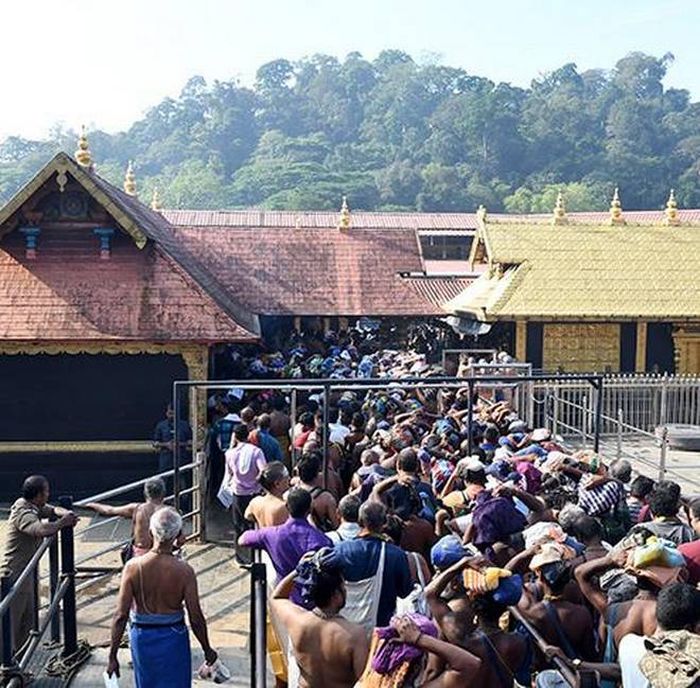
For example, in the Sabarimala case, there was no blanket ban on women of fertile age going into the temple until 1991 when the Kerala High Court, acting on a complaint by an individual named S. Mahendran, gave an order that henceforth, no woman aged between 10 and 50 can go to the temple. However, the judgment itself gave examples of how women, including the then Maharani of Travancore in 1940, had not only worshipped at the temple but participated in many temple ceremonies. The judgment said: “There was thus no prohibition for women to enter the Sabarimala temple in olden days, but women in large number were not visiting the temple. That was not because of any prohibition imposed by Hindu religion but because of other non-religious factors. In recent years, many worshippers had gone to the temple with lady worshippers within the age group 10 to 50 for the first rice-feeding ceremony of their children (Chottoonu). The Board used to issue receipts on such occasions on payment of the prescribed charges.” Surely Ms. Irani could have apprised herself of these facts.
The truth is that Ms. Irani was reflecting the doublespeak of the BJP, its government, and its mentor, the RSS, on their approach to temple entry for women, just as they had in the case of the Dalits’ right to worship in temples. While the RSS talks of a pan-Hindu unity, across castes and regions, the Sangh Parivar has always stood on the side of upper-caste orthodoxy, hurling stones, bricks and sticks at Dalits who dared to enter temples. The policy of the present Left Democratic Front government in Kerala for reservation of posts for Dalits and Other Backward Classes in temples, the first and only such social reform policy in the country, enraged the RSS but it had to back down after a few unsuccessful attempts to mobilise other sections of priests. As far as women’s entry into temples is concerned, the hypocrisy is equally evident. In Maharashtra, the RSS first opposed women’s agitations to enter the Shani Shingnapur temple, but after the court’s intervention and when the BJP-led State government was put in a spot, the RSS had to welcome it. In Kerala, the RSS first supported the Sabarimala judgment, but when a section of devotees protested, it took that as an opportunity to push its anti-Left retrograde agenda, did a U-turn, organised protests, and is now dangerously working to inflame religious feelings and communal tensions.
The Congress’s flip-flop
The widespread Left-led campaign to explain the issues is gaining public support, and surely the people of Kerala and, indeed, citizens across the country will reject the toxic politics of the RSS-BJP. But what of the Congress party? In contrast to the first statement of their all-India spokesperson welcoming the judgment, against their own history of linkages of social reform with the national movement, in Kerala today the Congress shamefully stands with the BJP and the RSS. Not only has it taken a virulent stand against the judgment, it has also demanded a Central ordinance to reimpose the ban on women’s entry. Yet its national leadership has fallen strangely silent.
Brinda Karat is a member of the CPI(M) Polit Bureau and a former Rajya Sabha MP
Courtesy The Hindu