By: Sushant Singh
During or immediately after the 1962 India-China border war, Soviet Union provided no military assistance to India while Washington was generous with offers to Jawaharlal Nehru’s call for help. Barring that small blip, Moscow has always stood by India, both in providing latest military equipment and classified military technology — say, nuclear submarines — which no western power will ever provide.
It all started with the Mig-21 fighter aircraft which Moscow decided to sell to India in 1961. It had entered service with the Soviet Air Force only in 1958 and India was the first country to get it. Not only that, Moscow was willing to permit licensed manufacturing of Mig-21 in India, and extend credit for manufacturing. As Indian Air Force (IAF) expanded after the 1962 War, it considered three aircraft for induction: British Lightning, Soviet Mig-21 and American F-104 Starfighter. The IAF found the British aircraft unsuitable and chose the F-104 Starfighter.
The US had already given F-104 Starfighter to Pakistan in 1961 and it was expected India would get it without any opposition in Washington. But India was instead offered the much inferior F-105 Freedom Fighter, if it could not make do with the British Lightning. India rejected the American offer. As per the 1961 Mig-21 contract, the first six aircraft were scheduled to be delivered to India in December 1962 but it was held up for months as India awaited clearance of the American sale. Finally, the six Mig-21 aircraft arrived in mid-1963, which formed the No 28 Squadron of the IAF; the Soviets also assisted in providing construction facilities for its licensed production in India.
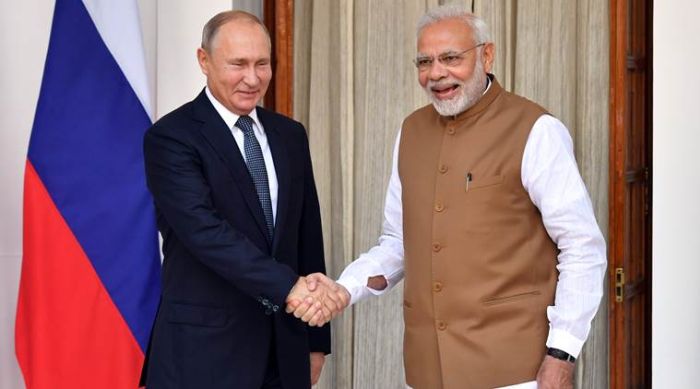
This was a major turning point in the military relationship between Delhi and Moscow, which was on display again last week as President Vladimir Putin and Prime Minister Narendra Modi witnessed the signing of the $5.3-billion deal for five S-400 air defence systems, despite the clear and open threat of US sanctions under CAATSA. It is the second-biggest defence deal of Modi’s tenure, after the controversial Rafale deal with France, and unlike the Rafale deal, Delhi has not insisted on even a paisa worth of Indian defence manufacturing offsets from Moscow. That tells us of the importance of this deal to India.
Why has India gone ahead with the S-400 deal despite Trump administration giving no clear signal that Delhi would get a waiver from sanctions under CAATSA? As Air Chief Marshal B S Dhanoa said last week, the S-400 will be a “booster dose” for his force, which currently has an obsolete air defence system. But the S-400 is a defensive system, and the IAF equally desperately needs fighter aircraft which are its sword-arm. The state of its fighter aircraft inventory is critical at the current level of 30-31 squadrons and they need to be built up to 42. The IAF has been pressing for more aircraft but we have not seen a similar desperation to procure fighter jets from Russia or elsewhere.
Clearly, there is more than that meets the eye about the S-400 deal with Moscow. The big question is about the dependency of the Indian armed forces on Russian spares for two-thirds of its military hardware. Despite protracted negotiations, the two sides have not been able to find an answer to the vexed problem which has seen Russian fighter jets in the IAF fleet operate barely at 50 per cent serviceability, a fact noted by the CAG. The situation is no better with the Navy. This need to keep its military platforms operational makes India vulnerable to Russian demands, a factor likely to have played its part in the S-400 deal.
India had taken a strong view initially when Defence Minister Nirmala Sitharaman said she didn’t care for CAATSA as it was an American law. The signals from her American counterpart were positive, raising hopes in Delhi, but nothing concrete eventually emerged. India then signed the long-pending foundational military agreement COMCASA during the inaugural 2+2 meeting, but there was no assurance of a CAATSA waiver in return. NSA Ajit Doval also paid a much-publicised visit to Washington to meet the major US principals soon after, where the S-400 is believed to have been a significant point of discussion. But there was no clarity about the waiver. American officials say the decision will be taken by President Trump himself, and considering his recent remarks about trade with India, no one is sure which way he will turn. Adding to the uncertainty is the fact that the White House has not yet confirmed its response to the Indian invite to be the chief guest at next year’s Republic Day parade.
With President Trump having imposed sanctions against China under CAATSA, the American threat cannot be dismissed as a non-serious one. Delhi, however, can’t succumb to American pressure, if it has to safeguard its interests in the tumultuous geopolitical environment, which majorly impacts India in its neighbourhood. Going by its recent actions vis-à-vis Moscow, Beijing and Washington, the current Indian government is keen on doing so. Delhi may be averse to using that phrase today but this fits in snugly the original conception of Nehru’s non-alignment. That is how the cycle of history works.
Courtesy Indian Express