By: Muneeb Qadir
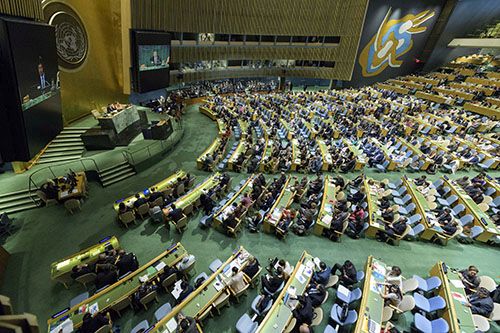
Nothing could be a better depiction of the divided world we live in than the preceding week’s UN General Assembly session. On the one hand there were – as Foreign Minister Shah Mehmood Qureshi rightly said – “forces of populism” advocating for greater borders and isolationist international policies, and on the other there were voices advocating for greater international integration and interdependence.
This is precisely the contradiction that is playing itself out in the modern world. The very foundations of the UN were based on a liberal world order, where democracy was to be the benchmark of an egalitarian, tolerant society, and where the rights to self-determination were to be protected, bringing an ever-closer international union.
The underlying aim behind this vision was straightforward: to avoid the horrors of the two world wars that had been witnessed in the run-up to the formation of the UN in 1945.
However, a cursory glance at the direction that international politics has taken in the last decade or so makes it clear that the UN’s simple constitutive principles have been fading away with each passing day. There is a growing wave of populist sentiment in mainstream politics, especially within several European countries, which is an unprecedented trend.
Austria, Poland, Hungary and Italy are faced with rightwing governments where dissenters are hunted down and forced into silence. While the Law and Justice Party in Poland has attempted to undermine judicial independence, Viktor Orban-led Hungary has just been threatened with losing its voting rights in the EU Council due to its crackdown on dissenters and journalists. Meanwhile, the coalition government in Italy – whose interior minister is Matteo Salvini, the leader of the rightwing League party – was recently responsible for refusing to provide a safe harbour for the migrant ship Aquarius.
When we look at African countries where human rights violations have been rampant for decades, the situation still appears to be unchanged. Although Zimbabwe witnessed the overthrow of Robert Mugabe, it is still led by Mnangagwa who was complicit in widespread human rights abuses while he was Mugabe’s right-hand man, making it difficult for citizens to not shed light on his past.
Similarly, Uganda is facing serious political turmoil in the form of its upcoming presidential elections, which resulted in the brutal arrest of Bobi Wine, the opposing candidate, at the hands of the country’s dictatorial president, Museveni. The killing of Gaza’s citizens by Israeli defence forces has also made matters worse. In addition, the crackdown on separatists in Hong Kong by the Chinese government highlights one of the many prevailing tensions within Asia.
Amid this global context, what were the highlights of the UNGA session? Although Trump put his anti-migration, anti-trade and anti-globalisation perspective forward, he was greeted with laughter from the global community. However, that did not act as a deterrent for India to present a similar stance, filled with mudslinging of the worst kind towards Pakistan, as Indian External Affairs Minister Sushma Swaraj explained India’s desire for peace without relying on the need for a peaceful dialogue over contentious issues such as Kashmir and the alleged violations of cross-border ceasefire violations.
By contrast, countries like France and New Zealand presented a pro-globalisation and pro-trade stance, with the New Zealand PM Jacinda Ardern taking a stance completely opposite to that of the US president.
Interestingly, and unexpectedly, Pakistan’s stance, presented by Shah Mehmood Qureshi, was also in line with this latter group. Despite India’s disappointing rebuff, our foreign minister reaffirmed the need for dialogue among the world community and greater interdependence.
Although UN members appear to symbolise the deeply divided world on the basis of different ideologies, as long as there are subscribers to the latter group of states there is still hope for a return to the original values of the international body.
Courtesy The News (Pakistan)