By: Muralee Thummarukudy
There have been many distinguishing facts — high literacy, deep penetration of grassroots democracy, high degree of women’s empowerment — that set Kerala apart from other Indian states. In fact, economists often discuss the Kerala Model of Development, where an improved quality of life was achieved without a massive increase in per capita income.
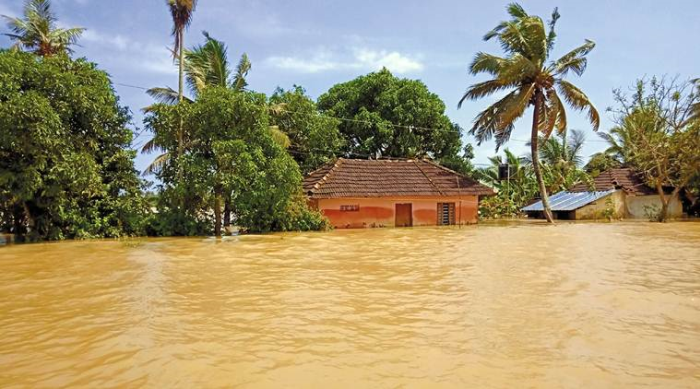
All of the above qualities came in handy when Kerala was faced with the dual disaster early this month. As the biggest flood in a century marooned over a million people in their homes, it was not the official systems that managed to rescue them or arrange relief. People from all walks of life — fishermen to IT professionals, housewives and college students — came together to lend a helping hand.
As the state administration was overwhelmed by a large number of rescue calls, many of them without complete information and often in duplicate, young professionals sitting around the world quickly established a 24×7 help-desk that received the calls, eliminated duplicates, found exact coordinates from Google Earth and relayed precise information to the rescue teams. Relief camps came up all around and there was no shortage of resources. While a few camps did have shortages of food or dress in the initial days, the bigger problem was that an excess of supplies came from near and far. Caste, religion, political ideology did not matter in the rescue and relief operations. It was Kerala at its best.
While Kerala did exceptionally well in post-disaster rescue and relief, its performance in the pre-disaster situation was not as exemplary. Since 2012, I have been warning that a flood similar in dimension to the one in 1924 (Flood of 99, as the old generation called it), will come. I had also said that land-use near the rivers has been modified on the false protection offered by the large number of dams built in the last 50 years. Based on my experience in Pakistan and Thailand, where dams extended the floods and exacerbated the misery, I had called for better attention to land-use planning and improved coordination of reservoir management.
I was home for the holidays in May 2018 and my mother told me it had been raining since mid April. Normally, the monsoon begins only in late May or early June. So, incessant rain since April was an indication of the shape of things to come. In mid-June, as the monsoon intensified, I posted on my Facebook (which has over 70,000 followers) that it was customary for the media in Kerala to call me after a disaster and my preference was to be spoken to before a disaster happens. I will give you a clue, I told media personnel.
Sadly, this clue was also not followed up. Now when everybody, from Opposition leaders to laymen, is asking why were dam spillways not opened earlier so as to create holding capacity to absorb excess rainfall upstream, which could have reduced the intensity of the flood below the dams, the dam operators have no convincing answer except to blame the weather forecast. In fact, modelling of reservoirs only needs rainfall trends, and not precise long-term forecasts. While I am not privy to the exact background to various decisions, my assumption is the latest tools of reservoir management are not available to dam and reservoir managers.
But now is not the time to find fault with individuals or institutions. Kerala needs all the help it can get from every source, be it funds from the Centre or the best technical practices from the international community. But before rushing into rebuilding, we should understand that if we were to rebuild Kerala as before, we are recreating exactly the same vulnerabilities that existed before. That would be an irresponsible act.
In Japan, after every tsunami, people place a stone marking the extremities of the tsunami so that later generations can see a mark beyond which they should not build. No such effort was made either by the government or civil society after the 1924 floods. A good start for reconstruction by the current generation will be to mark the flood levels, in their homes and in every public place (schools, government offices, temples etc), so that this information is handed down to the next generation.
But we should not focus our attention on just flooding, as we plan rebuilding. People often make the mistake of thinking about the last disaster and not the next one. Apartments were safe during this event as people took shelter in the higher floors. Already there are advertisements promising “flood-safe” apartments. But the next disaster in Kerala could well be a fire in a high-rise apartment. So moving people from riverside villas to apartments downtown is only transferring the risk, not reducing it. Only integrated land-use planning based on multiple risks can truly achieve sustainable disaster risk reduction.
It is also time Kerala took climate change seriously. Both sea-level rise and high-intensity rainfall are going to make flooding more frequent in Kerala. Some low-lying parts of Kerala, such as Kuttanad and Ernakulam town, are particularly vulnerable to flooding. Cyclone Ockhi has demonstrated that Kerala is also susceptible to cyclonic winds. So, future Kerala also has to be designed keeping the changing climate in mind.
The United Nations Environment Programme has been promoting ecosystem-based approaches to disaster risk reduction and climate change adaptation. In the context of floods, for example, what needs to be done is to reserve enough land for the river to expand at the time of flooding. That means disallowing the building of houses near rivers and reserving the land for agricultural purposes. Besides, it should be declared in advance that farmers will be compensated for losses due to floods. If there are cities near rivers, they will have to be protected by safety walls. However, the density of population should not be allowed to rise beyond a point, as is followed in Europe now.
Courtesy Indian Express