By: Susan Kurdli
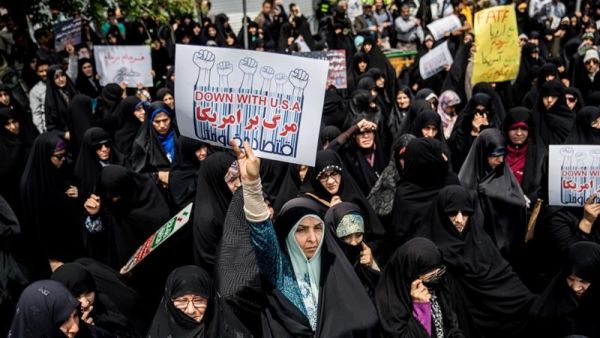
From the free fall of the Iranian rial, to street protests demanding regime change, to the death sentence pronounced by the US towards normalised trade following the abandonment of the JCPOA known as the Iran nuclear deal, there is no shortage of news reports detailing the myriad “existential” crises the Iranian regime is currently facing.
Therefore, the state must be on the verge of collapse, correct?
The problem is that none of these crises is a new phenomenon for the regime. Since the 1979 revolution, which toppled the Shah and instated an Islamic government, the Iranian state has proven to be one of the most resilient in the region. It has survived a plethora of social, economic and political crises, including an eight-year war with its neighbour Iraq – starting only one year after the revolution and ending in 1988 – unilateral sanctions by the US in 1979 and joined by the UN in 2006 and the EU in 2016, the 2009 Green Movement protests where hundreds of thousands questioned the legitimacy of then-President Mahmoud Ahmadinejad, to name but a few.
In this regard, heightened pressure on the regime by the US and regional allies such as Saudi Arabia and Israel not only threatens an already politically fragile region but also misses the mark on the appropriate policy to be implemented.
As a matter of fact, isolating the Iranian economy and society only fosters mistrust from the Iranian community and damages any political goodwill that would help in future negotiations with the state. Not just that, but prolonged isolation has only worked to legitimise the hardliners’ stance within the Iranian government while sowing doubt in the reformist agenda, which, since the presidency of Mohammad Khatami in 1997, called for normalised diplomatic and trade relations with the rest of the world and extended personal freedoms. Although current President Hassan Rouhani is a centrist, he was supported by the reformists during his reelection in 2017 and he has renewed efforts to rejoin the international community, with his administration carrying to completion the JCPOA.
In light of this, strengthening trade and investment relations with Iran – instead of imposing sanctions to isolate and weaken the leadership – would improve the negotiating stance of the moderate current in Iranian politics as well as provide stability and economic growth in Iran and beyond. In addition, scholarship on international trade policy suggests that increased trade could have a positive impact on democratisation by instilling human rights norms and principles and the promoting their institutionalisation.
This approach not only ensures the welfare of all civilians; including Iranians, those in the region and elsewhere; but would also give its people a chance at pursuing an organically homegrown sustainable democracy instead of adding further to the instability in the Middle East.
Iran’s civil society is active and sophisticated. It elected the secular democrat Mohammad Mosaddegh in 1951 with his agenda of reclaiming national resources. It is the same civil society that expressed dissatisfaction with the despotic rule of a Shah reinstated through a joint CIA-MI6 plot in 1953 and eventually rebelled against him, ending his rule.
Today, Iranians are still grappling with an autocratic regime. Opening channels of trade and investment would allow for a politically mature civil society to gradually transform the nature of this regime by empowering civilians and local businesses who in turn could exert pressure on the government and organically demand change. Iranians are capable of shaping their political landscape, the international community’s role is to provide the tools for them to pursue their wellbeing.
Courtesy Aljazeera