By: Salman Anees Soz
The Partition and the bloodletting that accompanied our Independence took up much of the energy of our founders. An opinion piece by an unnamed Indian official in the October 1952 issue of Foreign Affairs magazine describes the challenge: “In its [Partition’s] wake came the immense task of organising, within a few weeks, the movement of no less than 6,000,000 refugees, of improvising arrangements for their immediate relief, and devising plans for their permanent resettlement and rehabilitation. When was a ‘refugee problem’ of this magnitude set before an untried government in the very first days of its existence and solved with equal expedition and success?” There was no significant foreign assistance to deal with a refugee crisis that was second in scale only to that generated by World War II. While presenting the first Budget of independent India on November 26, 1947, Finance Minister R.K. Shanmukham Chetty noted that the immediate impact of the Partition’s “tragic developments has been to divert the attention of the Government almost completely from normal activities”.
A difficult start
The Partition was an unwanted addition to an already full plate of immense problems. Most of India’s 350 million people then lived in staggering poverty. One of the biggest problems was that of food, or the lack thereof. The Bengal famine of 1943, which claimed three million lives, was still fresh in memory. In his maiden budget speech, Chetty noted that India’s “food position has continued to cause grave anxiety both to the Provincial Governments and the Central Government”.
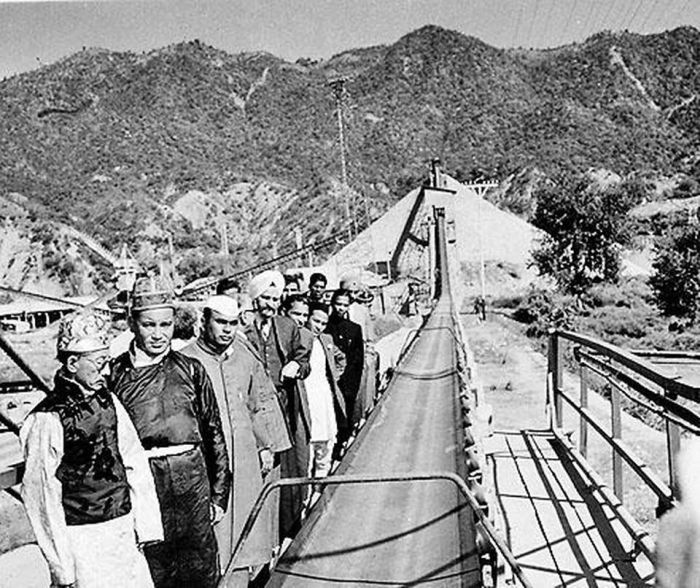
Writing in 1958, more than 10 years after Independence, the economist John Kenneth Galbraith was of the view that India’s villages, where over 80% of Indians lived, were “preoccupied, with the production of food”. Galbraith noted that “Indian economic life as a whole” was mostly about food production. To address inadequate food production, our first government focussed on expanding India’s irrigation capacity. Chester Bowles, an American diplomat, noted in an opinion piece that India embarked on creating three large dam systems (Damodar, Hirakud and Bhakra-Nangal) that had an irrigation capacity 70% more than that of the Grand Coulee (in the U.S. state of Washington), which was at that time the largest irrigation system in the world. The breathtaking ambition of such an irrigation system at a time of deep uncertainties and insecurities is a marvel in itself.
Be that is it may, our founders were visionary and understood the need for balanced development. While today we keenly observe the ups and downs of the Index of Industrial Production (IIP), India imported 90% of industrial goods around the time of Independence. The Five-Year Plans that many mock today helped India’s industrial sector grow by an average of 7% over the 1950-65 period. The decline under the British was being reversed even as the basic building blocks of a new socioeconomic order were being put in place. In the 50 years before Independence, India’s GDP growth averaged about 0.9% per annum. During the first three Five-Year Plans, it averaged 4%. In 2018, we can say that 4% was low and that our founders were ineffective. Who in the year 1900 could imagine that India would grow at 4% a year over a 15-year stretch? In those 15 years (1950-1965), India’s average GDP per capita growth rate was almost 20 times that achieved during the 1900-47 time period.
Building blocks
Yes, Prime Minister Narendra Modi can call today’s IITs “India’s instrument of transformation” but he fails to express a sincere debt of gratitude to those who founded IITs. We can debate the quality of education in India but must also keep in mind that when India became free, the literacy rate was just 12%. The current government takes victory laps after reportedly electrifying 18,000 villages even as it whitewashes the fact that when independent India was born, only 0.2% were electrified. By the time Manmohan Singh passed the baton to Prime Minister Modi, 97% of villages had been electrified already. For those of us who want India to become truly great, developing an understanding of where India came from is essential. Otherwise, with the benefit of hindsight, we can mindlessly criticise past efforts and be distracted from our current context. After all, with all of the knowledge and expertise available in 21st century India, the current Prime Minister ended up enacting a disastrous economic policy of demonetisation that his predecessor described as “organised loot and legalised plunder”.
Never forget.
Salman Anees Soz, formerly with the World Bank, is a member of the Indian National Congress. Views are personal
Courtesy The Hindu