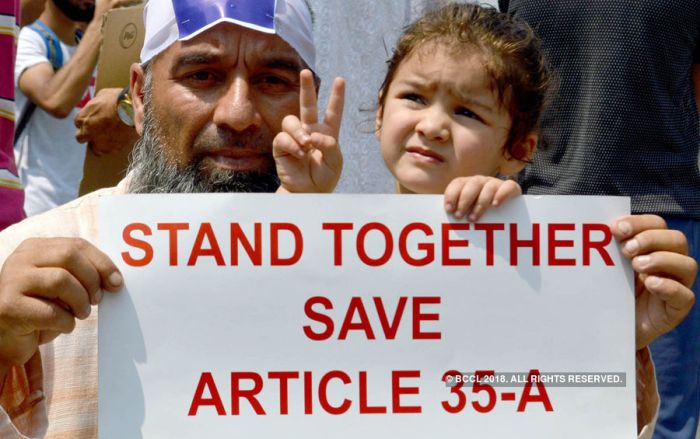
ARTICLE 35-A of India’s constitution says that no law for Jammu & Kashmir, existing or future, shall be void as being violative of the fundamental rights if it touches “permanent residents” or confers on them “special rights” on government jobs, acquisition of immovable property, settlement in the state or rights to scholarship or other forms of government aid. The supreme court is asked to declare it void for violation of “the basic structure of the constitution”. This doctrine only applies to constitutional amendments. It cannot apply to the constitution itself. Article 35-A was inserted into the constitution in 1954 by a presidential order made under Article 370 on J&K’s autonomy, which has been hollowed out.
The threat to Article 35-A poses an existential threat to J&K. Protection of permanent hereditary occupancy of land existed even a century ago. In The Valley of Kashmir, Walter Lawrence noted the curbs on alienation of hereditary occupancy of lands. “This right of occupancy is hereditary; but it is not alienable either by sale or mortgage.” It would be “dangerous” not to impose this curb; else “whole villages” would be sold for paltry sums.
In 1922, the princely state’s council of ministers imposed curbs on employment of outsiders in administration, as well as “all grants of land for agricultural and house-building purpose and grant of houses and other state property shall be made to state subjects only”. A notification in April 1927 defined them.
The basic principles committee set up by the J&K constituent assembly, presented its report on Feb 3, 1954. “All these fundamental rights should be subject to the overriding condition that: (i) no law of [J&K] relating to [J&K] subjects to be hereafter called ‘permanent residents’ and regulating their rights and privileges; and (ii) no law hereafter to be made by the [J&K] legislature defining the permanent residents and conferring on them special rights and privileges in relation to acquisition and holding of property in [J&K] or in the matter of employment under [J&K] and imposing restrictions on citizens other than permanent residents for settling within [J&K] should become void on the ground that it is inconsistent with or takes away or abridges any of the rights conferred by Part III of Constitution of India.”
On Feb 11, 1954, the report of the drafting committee was presented to the constituent assembly, in which an annexure set out the provisions of the Indian constitution, besides Articles 1 and 370, that should apply to J&K. Obviously, this annexure had been settled with the Indian government. Article 35-A was among them. On Feb 15, Girdhari Lal Dogra moved that a copy of the annexure be sent to the Indian government “for appropriate action”. On May 17, the president’s order under Article 370 followed, inserting, among other provisions, Article 35-A in the constitution.
It is part of a compact between J&K and the union. Repeal of Article 35-A — which is constitutionally impossible — will not alter the situation, for the 1927 notification is part of the J&K constitution.
Article 370 of India’s constitution records a compact between the centre and Kashmir, so does Article 35-A; Articles 370 and 35-A form an inseparable whole, which was negotiated over May to October 1949. It was agreed between Jawaharlal Nehru and J&K’s delegation headed by Sheikh sahib. Nehru recorded it in a note dated July 20, 1952. The terms of the agreement were explained to the Lok Sabha and to the J&K constituent assembly.
Article 35-A is not a mere executive order under Article 370 but is itself a constitutional provision, a compact recorded in both constitutions. No court can ignore this. As the Privy Council held “parliament could as a matter of abstract law” repeal the statute of Westminster recognising the independence of the dominions. “But that is theory and has no relation to realities.” Article 371-A of India’s constitution on Nagaland has similar curbs. The Mizo Accord of 1986 was effectuated by Article 371-G. No central law can apply to them unless their legislatures so decide.
The remarks made by the chief justice of India, Dipak Misra, on Aug 6, 2018, are therefore disturbing. He said he would hear the centre “and to some extent the J&K government, which has a minimal role”. The centre wants to remove Articles 35-A and 370. Kashmir’s very existence depends on their survival. It was represented by a lawyer in the employ of the centre, additional solicitor general Tushar Mehta.
It is not too late to register J&K’s voice; for instance, by an all parties’ convention; a white paper on Article 35-A based on the records; a declaration by the convention and an all parties’ delegation to the prime minister. A united front is necessary. The supreme court must not walk into this thicket.
Courtesy Dawn