BY: Anne McCall & Ravi Palat
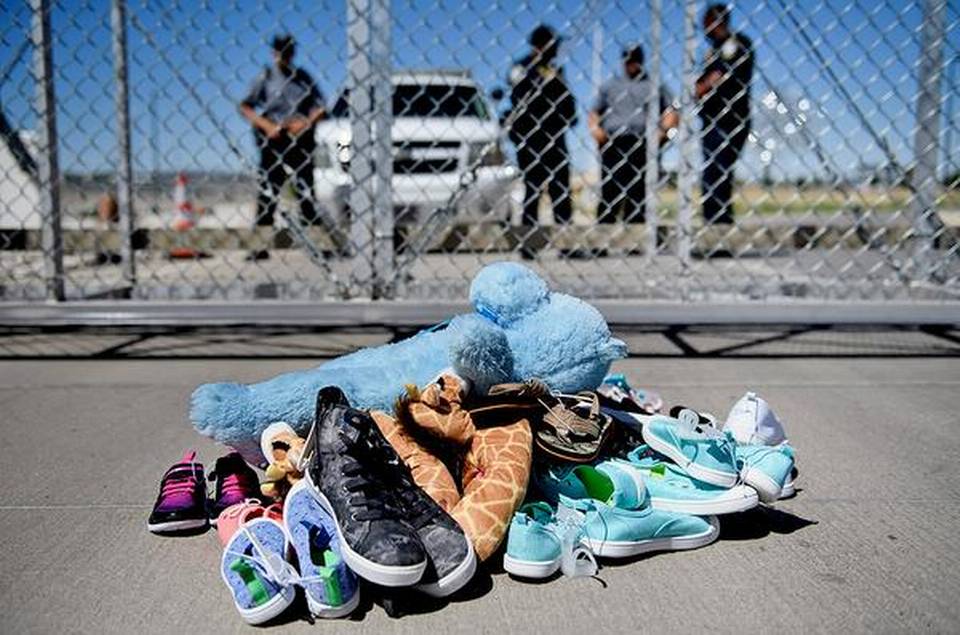
Heartrending scenes at the southern border of the U.S. have dominated world headlines after the Trump administration implemented a ‘zero tolerance’ immigration policy. In these, children, some as young as seven months old, are shown being torn from their parents’ arms and sent into detention without their parents being informed of their whereabouts. Video footage of these children imprisoned in cage-like detention centres, and audio tapes of their anguished cries, have unnerved even President Donald Trump’s most ardent supporters.
Every Republican Senator has publicly opposed this forced separation of children from their parents. Evangelical supporters like Franklin Graham said it was “disgraceful”. The United Nations said it “may amount to torture.” All the former First Ladies, and even First Lady Melania Trump, intervened in protest.
Routine brutalities
Despite the outrage, police brutality towards children and the separation of children from their parents is nothing new in the U.S. Mr. Trump is merely the most vicious and crude manifestation of it. What is new is the scale of the Trump administration’s ‘zero tolerance’ policy towards undocumented migrants and the incarceration of thousands of children. What stirred the outcry was the spectacle of young children crying as their mothers were handcuffed and led away. This was newsworthy, while the routine brutalities and family separations at the local level have been going on for centuries, given the history of conquest and slavery. Indeed, there has been little outrage in the media at the more recent detention of unaccompanied migrant children.
In 2007, when a Guatemalan woman named Encarnacion Bail Romero was arrested during an immigration raid, her 11-month-old baby was taken away from her and placed in a foster home. That foster family then adopted the baby and his birth mother could not fight the adoption because she was in jail, spoke little English, and was not provided a translator in court. This is just one instance among many.
School authorities in several districts routinely summon police officers to handcuff and arrest children as young as six and seven years old for assaulting teachers, for damaging school property, or even for simply throwing a tantrum. In low-income neighbourhoods, rather than providing an avenue for upward mobility, schools have become highly policed zones which strengthen racial inequality and distrust so much that the ‘school to prison pipeline’ has become a characteristic of social life in the country.
As state and federal budgets have been slashed, local governments have been using fines and fees as a source of revenue. In California, for instance, running a red light cost an offender $549 in 2014: $100 for the offence and $449 in added fines, fees, and assessments. These fines covered the costs of arrest warrants, court-ordered drug, alcohol and DNA tests, salaries of court employees, heat and air conditioning costs of the court house, and even the county employees’ fitness gym.
When the U.S. Federal Reserve estimates that 46% of people in the country cannot raise $400 at short notice in an emergency, the inability to pay such punitive fines leads to more fines and eventually to imprisonment. One-third of all felony defendants in New Orleans spend their entire pretrial period, each averaging a four month stay, in jail because they can’t post bail. This is criminalisation of poverty — and it bears disproportionally on the vulnerable, on the brown and black minorities.
Strikingly, the widespread condemnation of Mr. Trump’s ‘zero-tolerance’ policy doesn’t place it within this wider context of the separation of children from their parents at the local level. The routine brutalities visited on these children have inured the U.S. population to the fundamental immorality of the situation. Acceptance of poor people being separated from their children because they can’t pay relatively small fines normalises family separations and helps justify the practice. It is why 90% of Republican voters still support Mr. Trump.
Rhetoric and racism
This suggests that once the news media moves on from covering the children in make-shift detention centres, we will be back to the separation of children of undocumented migrants. Precisely because the overwhelming majority of these migrants are of non-European descent, Mr. Trump’s rhetoric against them — calling them ‘animals’ and an ‘infestation’ — plays into the deep racism of the population.
Indeed, he built his successful candidacy on the issue of undocumented migration even though the numbers had fallen — they are now a third of what they were under Presidents George W. Bush, Bill Clinton, or even Ronald Reagan. Since 2008, they have fallen to levels not seen since the 1970s. Despite the President’s claims, these migrants are also not criminals. Crime statistics consistently show that immigrants have much lower rates of criminality than native-born U.S. citizens.
Yet, in an era where income inequalities are rising — and rising even faster after the tax cuts for the wealthy that Congress recently enacted — and as automation and numerically controlled machines are increasingly replacing skilled labour in manufacturing, hypocritically evoking the spectre of foreigners stealing jobs in the U.S. is a strategy to deflect public anger from the affluent.
Mr. Trump’s anti-immigration stance is the domestic counterpart to his trade wars with the country’s major trading partners. While both these strategies may help him with his core supporters — his “base” — in the short run, these very supporters will be hurt in the long run: without transient and poorly paid labourers in the farms and in the service sector, costs will rise. With higher tariffs, manufactured products would cost more as supply chains now span the globe. With countervailing tariffs imposed by trading partners, U.S. farm and industrial producers will see a fall in their earnings.
But so successfully does Mr. Trump’s message resonate among the people who experience job loss and drops in their income that the Republican establishment is afraid of making the President cross. It is not at all clear whether the spectacle of families of undocumented immigrants being torn apart will signal a change. Any meaningful change will have to address not only the causes of migration from Central and Latin America but also the criminalisation and racialisation of poverty in the U.S.
Courtesy The Hindu