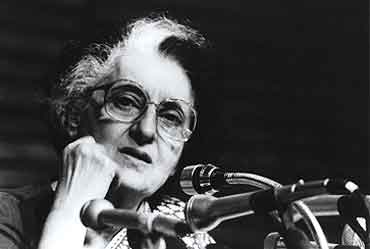
JUNE 26 marks the day Indira Gandhi imposed her 21-month-long emergency rule on India in 1975. There will be the usual seminars to remember the occasion, and an old book by two intrepid journalists is also planned to be re-released, a classic of its time on the landmark event. I was a student at the Jawaharlal Nehru University (JNU) when a few of my leftist comrades were picked up.
They included Devi Prasad Tripathi or DPT as his Pakistani friends would come to know him, the one who organises literary seminars and discussions on the peace that eludes the two countries. Why he left the Communist Party and how he joined Rajiv Gandhi’s kitchen cabinet (and got me his first exclusive interview as prime minister) en route to becoming a Rajya Sabha MP with the Nationalist Congress Party makes for a riveting mystery. Tripathi was in jail for nearly the entire duration of the crackdown and despite his political drift remains a solid voice for India’s secular democracy. This cannot be said of many others who were locked up with him.
Among those Mrs Gandhi arrested were Atal Behari Vajpayee, Lal Kishan Advani and Arun Jaitley of the Bharatiya Jana Sangh. Post-emergency, they merged into the Janata Party and Vajpayee later revived it as the Bharatiya Janata Party or BJP. The switch followed a new rule that Janata Party members could not remain attached to the Rashtriya Swayamsevak Sangh (RSS). Eventually, the gallant fighters for democracy decided that the semi-fascist alma mater was dearer than the coalition to thwart Mrs Gandhi.
When they left they had already done the damage. The RSS component in the Janata Party got a ban on school textbooks penned by renowned historians. Advani as information minister wasted no time in spreading his communal poison. I still remember the black-and-white 1950s movie Advani showed on state-run Doordarshan. In it a Hindu wife successfully campaigned to drive out Christian missionaries from her village as they had cast a spell on her husband. The missionaries left and the mute man was healed.
Later, a TV serial on Tipu Sultan was cleared by an RSS censor only after the director agreed to say before each episode that the characters were fictitious or imaginary. The stipulation was never required for the mythologies that followed. There were a hundred things wrong with Indira Gandhi but I can’t remember an occasion when she used the media to divide people or promote quackery.
To illustrate the range of her allergens perhaps Mrs Gandhi also sent Lalu Prasad Yadav to prison. He kept his humour intact and named his daughter Misa, after the Maintenance of Internal Security Act, under which he was jailed. Yadav rose to become a beacon of opposition to the RSS, and has remained a bête noir for the BJP, which put him in jail. He says he is waiting for his turn to get even with his tormentors.
It is evident that Mrs Gandhi did not discriminate between left and right in curtailing their liberties. The question then is what propelled her to take the harsh step. It is possible that the emergency had to do partly with the cat-and-mouse game of the Cold War. After the humiliation in Vietnam, the US was a wounded animal fighting back viciously to retrieve its pedestal as a superpower. South Asia was naturally thrown into ferment. The pro-Soviet Mujibur Rehman was assassinated in Bangladesh fewer than two months into Mrs Gandhi’s emergency. The two were Cold War allies. American protégé Ziaul Haq would be waiting for his turn to play his role, which came with the Soviet push into Afghanistan. It was not a coincidence that the pro-Soviet communist party had supported Mrs Gandhi’s emergency.
In fact, JNU students fighting the battle in a nocturnal prowl felt it safe to keep their stencil machine and other handy implements in the room of a genial pro-Moscow Urdu scholar and by implication a supporter of Indira Gandhi.
There was thus something tentative, even reluctant with an aura of self-doubt, about Mrs Gandhi’s crackdown.
Much has been made of the censorship she imposed on the media. Did she need to? Had she lived today, she would have chortled with delight. Just look at the newspapers and TV channels today, too eager by half to serve the powers that be, but not averse to picking up some cash along the way with paid news. Did Mrs Gandhi need censorship given the kind of media houses she so easily overwhelmed?
When people talk about an undeclared emergency under the four-year-old Modi government, we should sit up and pay heed. Daily threats to journalists, the mysterious murders of their leading voices, the lynching spree nationwide with the fingerprint of the state apparatus, the assault on defenceless men and women and children, invite comparison with 1975.
Another question is: if the emergency was bad for democracy, why was the provision kept in the statute books? When will it be kosher to impose an emergency again? Suppose a ruler has the judiciary, the president, the army and both houses of parliament in his or her pocket. What then? Who can stop anyone from being wilful as Charlie Chaplin was in the Great Dictator?
“Emergency should be used only for external threats,” goes the clever argument. But a war is the easier ruse to go to town with these days. Today, you can declare war on TV without having to fight one. The media will do the fighting. People have been jailed over laughably vacuous assassination plots. Mrs Gandhi jailed her quarries for plotting to overthrow the state and its secular constitution. That threat to India’s constitution has grown, not abated. In fact, the threat is as palpable as it was 43 years ago. Only this time it comes from the rulers themselves.
Courtesy Dawn