By: Khurram Husain
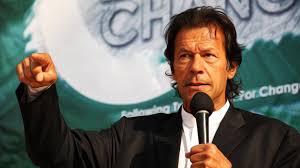
HERE is what I don’t get: all the people and parties criticising Imran Khan’s 100-day agenda presented over the weekend, how come they don’t have anything like a vision for what they will do once they are in power? There is lots to say about Khan’s 100-day agenda, and I deliberately call it Khan’s agenda because that is how it is described in the party’s documents and presentations too. But it would be great if other parties could give us something to compare with Khan’s agenda.
The PML-N has claimed that Khan’s agenda is a “copy and paste” job from their own Vision 2025. They also ask where the resources will come from to create 10 million jobs, as Khan’s agenda says it will aim to do (during a five-year term mind you, not in the first 100 days as some mistakenly assumed). First of all, there is a huge difference between the Vision 2025 document and Khan’s agenda, so the allegation that the latter is copied and pasted from the former is totally wrong.
Take for example what each document says about police reforms. The Vision 2025 mostly talks about the importance of effective policing; the only time where it advances a way forward is when it talks about the need to “enhance the capacity of police, prosecution and public defenders’ system”. From there it moves on to a “a new security policy will be prepared to tackle the issue of terrorism”, the elimination of “thana culture” through a citizen police liaison system, a “local police system” and the creation of national and provincial databases “of criminals” in coordination with Nadra. One is tempted to ask: how much of this has been done in the past five years?
Khan’s agenda, by contrast, presents the Khyber Pakhtunkhwa model of police reform which will be built upon to reform the entire country’s police systems. At its core, it is about strengthening the independence of the police force from political interference. It aims to build on the model of the KP police reforms. The Vision 2025 document shies away from making any explicit commitment to promoting the independence of the police.
Another example is provided by how the documents aim to deal with the state-owned enterprises. Khan’s agenda calls for the creation of a “wealth fund” to remove the SOEs from the line ministries altogether. It also highlights the restructuring of PIA, Steel Mill, Railways and the power sector companies “on an emergency basis”, whatever that means.
The Vision 2025 also talks of restructuring, but at least mentions privatisation, whether “partial or outright”, though it’s not clear what a “partial privatisation” looks like (do we have any successful examples here?). Khan’s agenda makes no mention of privatisation.
One thing that distinguishes Khan’s agenda is that it is almost totally centred on the personality of one individual. It begins with a long description of the party leader, his cricketing success, philanthropic ventures and leadership skills. Down the page comes a mention of his “team”. And the document throughout is peppered with references to change “by emergency” or to “revolutionise service delivery”, meaning they envision a sudden break with the system and getting onto a new trajectory. This was the case with the PTI’s White Paper released before the election in 2013 as well. Five years later, does anyone in KP find that “government by emergency” has been brought about, or whether it has worked? This is the crucial question, upon which the party’s (or in this case, the Khan’s) credibility hangs.
One could go on, but at the end we all know how meaningless these documents eventually are. The hard binding constraints that the parties have to operate within once they come into power end up making them all look more or less the same, rhetoric notwithstanding. For all their claims of having turned the economy around, the PML-N has, in significant parts, been helped by luck. The fall in oil prices, the arrival of the Chinese (and no, Nawaz Sharif did not “bring” the Chinese to Pakistan; the Belt and Road Initiative was ready for implementation around the time he came to power), and the gradual receding impact of the great financial crisis of 2008, the crowning achievement of Musharraf and his coterie of toadies.
Each of these factors played a key role in putting wind in the PML-N’s sails. And what did they do with all this windfall? Their first budget had development spending of Rs762 billion, and their second to last budget, where development spending peaked, had Rs1,275bn. This is an appreciable increase. There were no tax reforms worth the name, other than the introduction of the active taxpayer list. There was no “restructuring of state-owned enterprises”, no “partial privatisations” and one clumsy attempt to privatise PIA. In fact, structurally, not very much changed at all, perhaps with a few exceptions like the new auto policy.
So where the track record of the parties in power is concerned, it is luck and the hard binding constraints that largely call the shots. Whatever their declared intentions at the outset, they are useful only for understanding the differences in approach that each might adopt. Where the PML-N emphasised large, high-visibility projects, the PTI prefers to place the emphasis on social service delivery. Though even here, they had to admit that foreign borrowing is a necessity and a few roads and bus services of their own may not be such a bad idea.
And finally, corruption. Here too the differences between the two parties are basically rhetorical only. Just look at how they spin Jehangir Tareen’s disqualification versus Nawaz Sharif’s. Fact is, the great Khan has surrounded himself with people of exactly the same stripe as his opponents, and no less corrupt. Making a programme out of retrieving funds stashed abroad is a losing proposition; just ask Musharraf (or his toadies if you can’t reach him). Besides, there is not as much there as Khan sahab imagines.
Courtesy Dawn