
In his first article upon becoming foreign minister of the Islamic Republic of Iran five years ago, in 2013, Mohammad Javad Zarif declared, in Arabic, to Asharq Al-Awsat: “[T]he reality is that [Iran’s] primary foreign policy priority is our region. Few things are constant in international politics, but geography is among them. A country cannot change its neighbours. In our interconnected world, the fate of one nation is tied to the destinies of its neighbours.”
Since 2001, when I met Dr Zarif as part of discussions between the United States and Iran about Afghanistan, I have heard him urge international parties to work with Iran and its regional neighbours to build a cooperative security framework that would transcend opposing states, alliances, axes, and blocs. Such a framework would seek to bring all regional states – even those with relations marked by serious differences – into a common forum. To join this forum, members would commit to resolving their differences within the parameters of well-recognised, internationally legitimated standards – for example “sovereignty, refraining from the threat or uses of force, peaceful conflict resolution, respect for borders and territorial integrity, non-interference in internal affairs of other states, as well as the right to self-determination within each state”.
After the US military intervention in Afghanistan in late 2001, aiming to overthrow the Taliban government, foreign policy elites in Washington basically argued that the US had a binary choice: for the US and its allies to militarily occupy Afghanistan and install a pro-American titular president or militarily “train” Afghans to do the job. From my position on then-National Security Adviser Condoleeza Rice’s staff, I argued that Washington instead should work with Central Asian capitals to create a cooperative regional security mechanism that could facilitate Afghanistan’s transformation from a battlefield for regional and superpower rivalries into a state that would not exacerbate other regional countries’ security concerns and could integrate economically with its neighbours.
This idea of a regional cooperative security mechanism in Central Asia – that would include Afghanistan and its six neighbours (Pakistan, Iran, Tajikistan, Uzbekistan, China, Kazakhstan) plus the two most influential external powers (Russia and the United States) – was shot down. Instead, the Bush administration sought to create a pro-American NATO-like military structure in Central Asia that would exclude China, Iran and Russia. Predictably, that effort failed, and Afghanistan today remains an economically underdeveloped and weakly governed source of serious threats to regional and international security.
Similarly, in 2003, when I had moved from the White House to work on then Secretary of State Colin Powell’s Policy Planning Staff, I argued that, in the wake of the US invasion of Iraq, the US should not compound its problems in the region with a military occupation of Iraq. Instead, a severely weakened Iraq could be brought into a cooperative regional security mechanism – much as Dr Zarif had proposed – that would also incentivise Iraq’s neighbours to integrate it more deeply into regional trade and financial flows. This idea, too, was rejected in favour of continuing the futile pursuit of highly militarised American domination of the Middle East.
I subsequently resigned from the US government because I was unwilling to help facilitate even more strategically disastrous US foreign policy choices. I believed at the time and still believe that Dr Zarif’s strategic concept for cooperative security building in the Middle East and Central/West Asia would have set these regions on more constructive trajectory in the 1990s, in the wake of the Cold War, and in the 2000s as the US proved after 9/11 that it could no longer achieve its goals through military interventions in Afghanistan, Iraq, Libya, Syria and Yemen. Today, though, I no longer believe this is a viable way forward.
Cooperative regional security depends on the governments of each state working to serve their country’s interests – not those of a foreign external power. But the dominant external power in the Middle East – the US – opposes genuinely cooperative regional security precisely because it would lead to foreign policy independence for more and more Middle Eastern states. Washington does not want a multipolar international order in which the US is one of several great powers; similarly, it does not want to deal with truly independent power centers in strategically vital regions like the Middle East. And America has proven over and over again that it will go to the most extreme lengths to preserve its empire, even if that ends up accelerating the dissipation of American power.
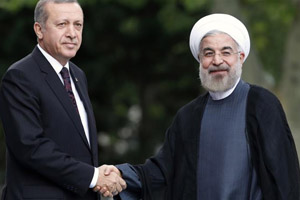
Dr Zarif’s vision implicitly presupposes the existence of at least a critical mass of regional states that are not just formally sovereign but also committed to foreign policy independence, for themselves and for their neighbours. In reality, though, relatively few Middle Eastern political orders are committed to such a proposition. The three most independent actors in the region – Iran, Qatar, and Turkey – all had to fight hard for their foreign policy independence. Iran had to seize it through its revolution in 1979, the AKP in Turkey had to overcome an entrenched pro-American military dictatorship, and Qatar had to defy much larger neighbours by investing billions in an LNG train to internationalise its markets, by securing diverse military partnerships, and by developing its media, aviation, and education networks to give it an independent platform.
But too many of the Middle East’s contemporary political orders are simply not constituted on bases permitting them to pursue genuine foreign policy independence – or tolerate its pursuit by other regional states. These orders – including, most prominently, Israel and Saudi Arabia – remain fundamentally dependent for their long-term survival on an American superpower committed to consolidating and maintaining dominance over Middle East security and political affairs. Such reliance compels them to oppose efforts by regional neighbours to chart their own paths. As a result, they regularly misrepresent commitment to foreign policy independence by states like Iran, Qatar, and Turkey as a “threat to regional stability” to justify their own coercively interventionist postures.
Only as independent regional powers prove capable of checking the worst impulses of regional actors ultimately dependent on a dominant America will they be able to promote cooperative regional security. Iran and Turkey recently provided a good example of what needs to happen when they came together to support Qatar resisting, and in the end, thwarting the expansion of Riyadh’s illegitimate assertion of hegemony over the Arabian Peninsula. That could be an important step in the long process of cultivating genuinely cooperative regional security across the Middle East.
Courtesy Aljazeera