BY: Shiv Visvanathan
Every riot today produces a set of staged narratives which are eerie to watch and strange to listen to. A riot is no longer an act of production where the narrative focusses on causes but an act of consumption where a variety of narratives create a quilt patch we call history. The actual event is enacted in a limited space, while the narratives of the event spread out in oceanic circles for consumption. The riots in Kasganj convey that quality and need to be seen within an analytical frame. Today, narratives of riots are the Rorschach test of a people, capturing their fear and anxieties.
Fractured narrative
This much is clear. It was riot on Republic Day, invoking a miracle gone wrong. In a way the performance already enacts the problematics of memory, not just that it was January 26 but the violence took place on Abdul Hameed Avenue in Baddu Nagar, a Muslim majority area. It was probably the most ironic tribute to a great soldier. Riots too often begin with a festival-like quality. The reports say a group of Hindus, or more specifically, Hindutva supporters, probably a mix of elements of the Rashtriya Swayamsevak Sangh (RSS), Bajrang Dal, were carrying out a victory parade on motorbikes. At the other side of town, a group of Muslims were celebrating Republic Day, hoisting a flag. In an earlier era it would have been a show of solidarity of a national event commanding the allegiance of its desperate citizens.
The rise of the Bharatiya Janata Party (BJP) has helped fracture this narrative. Today political solidarity seems to be a two-layered affair — where the icing of patriotism hides a huge chunk of communalism, where patriotism becomes what a communal majority defines it as. This leads to Muslims being asked to sing Vande Mataram when they feel that this insults their loyalty to the nation.
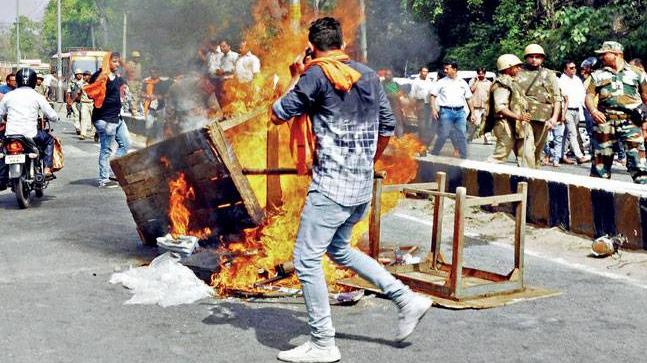
The motorcycle cavalcade moves to the Abdul Hameed avenue, the youths are armed with flags and swords. Even guns, as videos later testify. One almost senses a whiff of machismo and nationalism weaving together. Those in the Hindu cavalcade to assert its claim to history and turf insist on driving though the crowd hoisting a flag. A fracas ensues and in the resulting violence, a young Hindu man, Chandan Gupta, is shot. Of course another person was blinded and shops and vehicles gutted but all that is passive background.
At first sight, the Kasganj riot is presented as an archetypal riot around a standard scenario of small differences, two angry communities and a stumbling bureaucracy. Yet what brings irony and confounds this narrative is that the Kasganj riots took place on Republic Day. The communal and the national confronted each other to prove that patriotism today is not a secular loyalty but a majoritarian definition. As the events unfolded, the communal rhetoric takes over completely. Abdul Hameed must be turning in his grave.
The nature of narrative changes. It is no longer about solidarity but about communal accounting. The Vishwa Hindu Parishad (VHP) and Bajrang Dal desperate to settle narrative accounts equate the death of Chandan Gupta with the murder of Mohammad Akhlaq in Dadri. They talk about “the silence of Hindus”, of a need to balance narratives and compensation. The Akhilesh Yadav government in a populist move used the Akhlaq episode to give out doles — ₹30 lakh in compensation to Akhlaq’s family, ₹5 lakh to each of the brothers, and a flat to the family from some discretionary fund.
Recoding history
To the VHP and the RSS, history is about equivalence. If Akhlaq was immortalised by compensation rather than commemoration, Chandan Gupta deserved no less. He was to be declared a martyr, a shaheed, a patriotic servant of the country who died in battle. They demanded full security for Gupta’s family and demanded a compensation of ₹50 lakh. It was one-upmanship parading as concern, care and justice. It made one feel that the historic battles of liberation found a crass continuity in violence. Only riots offered you the possibility of compensation. Earlier, a martyr carried a symbolic halo and earned a ritual salute. Now history becomes a form of attraction and a victim of a riot makes some families cash-rich. One senses a recoding of history to fuel the fires of communal politics. Republic Day now is a continuation of communalism by other means.
Riots today are always enacted twice, once on the streets and once through video clips. One is tempted to modify the Marxist quote and add once as history and second time as a farce. One discovers that the flag cavalcade was a Tiranga Yatra, led by a communal mob known for its rowdy behaviour. To allow inflammatory speeches and threats on Republic Day makes little sense and says less about the Yogi Adityanath regime, which is treating it as a strictly law and order problem.
Watching the videos one senses a happy crowd full of children anticipating the ritual of flag hoisting. Suddenly a festival is marred by goons entering the narrow streets of the mohalla. A festival turns into a riot and a world changes. The brittleness of our society is obvious in these moments. The saffron flag overpowers the national flag, and the nationalist Muslim resists the second discourse. As the riots turn bloody, all media can do is ask for a probe. No one wants to ask how a Tiranga Yatra which is not quite nationalist was allowed on Republic Day. How could a national day be subsumed under a communal event? A mob tells the crowd, if you want to stay in India, sing Vande Mataram with us. Policeman signalling secular sensibilities are immediately transferred. Baiting minorities seems to be becoming a common sport with lumpen communal crowds. The bureaucracy will ritualise the inquiry. A probe will be initiated and the questions of Kasganj will die a natural death.
A show of bias
Kasganj has to be seen as a concrete event and as a metaphor for the emerging everydayness of riot-induced violence. As an event, one has to locate it within the history of violence in Uttar Pradesh. The 2013 riots at Muzaffarnagar are still etched in people’s minds. Riots today have become the second major source of displacement after dams. At this moment, for the BJP to ignore the wider demographics of riots and turn hysterical about compensating a victim is hypocritical. Chandan Gupta maybe a victim, but he is no martyr.
Second, it’s clear that the Tiranga Yatras have been threatening disruption. The fact that no anticipatory action was taken reveals the biases of the regime. Mr. Adityanath does not sound as immaculate an administrator as he is usually portrayed. His carte blanche to communal groups creates an ecology of threat and violence that makes a society feel brittle. It creates geographies of anxieties that minorities find difficult to cope with. As one hears the narrative, one sees a cycle of repetition and indifference, and also changes which increase the inventiveness of violence. Yet the administration has little to say to these events and maybe even the cause of many anxieties.
But there are bigger questions about riots and memory. Why are riots erased so easily from official memory? Second, what processes make riots a part of urban normalcy? Scholarship and investigation are required to answer these questions. Meanwhile, Kasganj will join the long glossary of violence from Meerut to Muzaffarnagar, taking democracy to its tipping point. When a regime is indifferent to such questions, civil society has to respond before such questions corrode the normative basis of our lives.
Courtesy The Hindu